190: Coaching Through the Seasons: Community, Confidence, and Creating Impact with P&PA Coaches Katie Doerksen & Julie Chutter
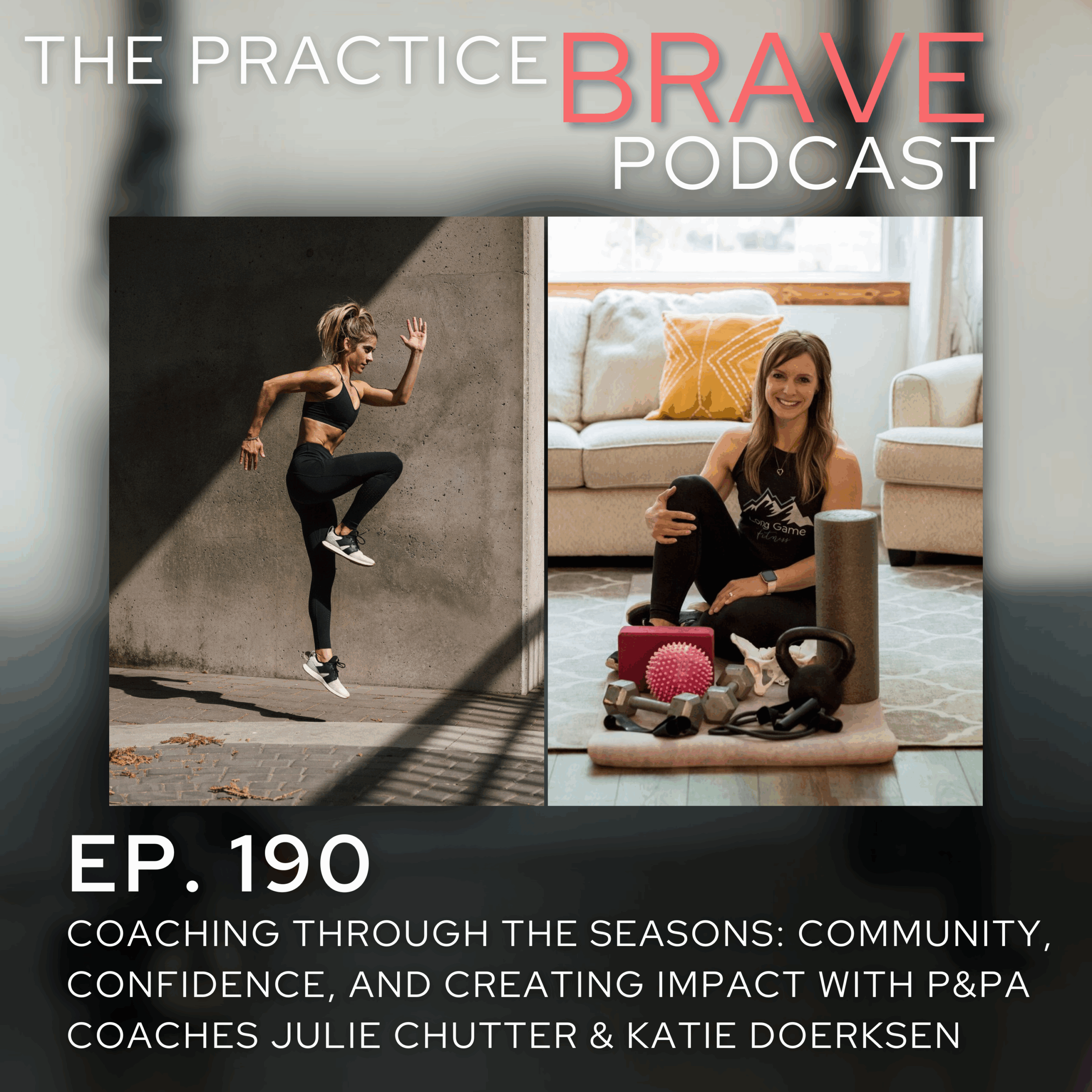
In this powerful and heartwarming episode, I sit down with two incredible P&PA (Pregnancy and Postpartum Athleticism) coaches — Julie Chutter and Katie Doerksen — to highlight how they’ve each built meaningful coaching practices while honoring their roles as mothers and leaders in their communities.
Julie, a mom of two based in Vancouver, shares how her background in spin and boxing led her to launching postpartum fitness classes — babies welcome — in a jiu-jitsu studio. We talk about building community, finding your rhythm during those chaotic early postpartum months, and how her business background has helped her thrive while staying present with her family.
Katie, a mom of three from rural Alberta, opens up about her transition from kindergarten teacher to strength coach and co-founder of Girls Who Lead — a program blending leadership development and physical literacy for young girls. She shares how she’s helping the next generation understand their bodies and embrace movement in a way that builds confidence for life.
We reflect on the real-life challenges of motherhood, the drive that comes with “athlete brain,” and the power of creating supportive, judgment-free spaces for women in every season of life.
Connect with Julie & Katie:
Julie Chutter
Website: movebyju.com
Instagram: @move.by.ju
Katie Doerksen
Website: longgamefitness.com
Instagram: @long.game.fitness
Join My Upcoming Workshop!
The No-BS Guide to Coaching Pregnant & Postpartum Athletes: What Every Coach + Athlete Needs to Know
When: Thursday, April 24, 8PM EDT
Register here: https://join.pregnancyandpostpartumathleticism.com/ppa-masterclass
EXPAND FOR EPISODE TRANSCRIPT
AUTO-GENERATED TRANSCRIPT
Brianna Battles 00:01
Welcome to the practice brave podcast. I am the host Brianna battles, founder of pregnancy and postpartum athleticism, and CEO of everyday battles. I’m a career strength and conditioning coach, entrepreneur, mom of two wild little boys and a lifelong athlete. I believe that athleticism does not end when motherhood begins, and this podcast is dedicated to coaching you by providing meaningful conversations, insights and interview topics related to fitness, mindset, parenting and of course, all the nuances of pregnancy and postpartum, from expert interviews to engaging conversations and reflections. This podcast is your trustworthy, relatable resource for learning how to practice brave through every season in your life. Hey everyone, welcome back to the practice brave podcast today, I’m here with Katie Dirksen, and I’m so excited to share about her journey as a pnpa coach, as a mom, as someone who really loves fitness. One thing we’ve been trying to highlight is real coaches, what they’re actually doing, what their background is, and how they’ve incorporated being a pregnancy and postpartum athleticism coach into their coaching, into their life, and like, how it’s translated in a lot of other things. And Katie’s a great example of that. So Katie, thanks for being here. Thanks for having me absolutely tell us a little bit about you. Your background, coaching all of that.
Katie Doerksen 01:28
Well, I’m a mom of three girls, so they are nine, seven and five. I’m wife to a farmer and entrepreneur. So we live very rural southern Alberta. I grew up moving quite a bit. My dad was involved in the military, but when we settled in, BC, I fell hard into gymnastics around the age of eight, and I did that all through junior high high school. And I would say that I would identify as like a recreational athlete with like a not an elite, but like a higher level mindset coming in and work ethic, so my skills don’t reflect the mindset often, but so I love gymnastics. I started coaching at age 12, and I just love being in the gym. And as I graduated high school, I started trail running, and just needed something, somewhere else to put that energy, put some routines in place. And when you’re training 16 hours a week, and then you go to nothing, you need to put something in to kind of reflect that, that work ethic and that, that break right? So I played around with running and went to university to become a teacher, and I had some experience teaching K to 12, mostly subbing, but I spent most of my time up to five years total, teaching kindergarten, which, again, it just comes full circle again and again for me, it’s like this early development stage that I I just love. I love the play involved and just starting from that foundation, and that’s probably what pulled me into pregnancy and postpartum and getting involved there, because you are again, starting from the ground up in a lot of ways. And after I taught kindergarten for a few years, I met Lauren, and we pretty quickly had our little girls, and we live so rural that childcare is a challenge. And also I love that I have the opportunity to be at home with my girls that’s really important to us. After having our third daughter, I had very different pregnancies. Tried to stay active. After having my third I was still frustrated about the answers I was given about working out or running during pregnancy, and it was like, you say anything from in the same pregnancy, do whatever you’ve you used to do to like, don’t lift over 25 pounds and just thinking like something’s not adding up. But then again, that athlete brain in it all the way, right? I can push. I can do it without knowing that statement of, well, can I or should I? I don’t know. So after having our youngest, I somehow came across some of your your content, and it really fell hard on me, I think, and I kind of dove in. And I think when I came to your coach seminar, I told you that, like this totally changed so many things for me because I was home. I’m an educated person. I i i wanted to use my brain in a way that was going to be beneficial, but I also don’t want to give up my time spent with my girls at home. So I took your coaching course online. It was everything I needed to, kind of get my brain on fire. I had no intention of starting a business, but it just, you know, one thing after another happens, and you encouraged me to also get my personal training, which I did that took me longer than the coach. Course, I’ll say, because I think I got so on fire for the pnpa stuff, that everything else was kind of secondary, but I wanted that backup of info as well. And from there, I just started a small business. From home, so I teach pregnancy and postpartum courses in small towns nearby. I also to do some group exercise just out of our community hall here in gem. And then a couple years later, I started girls who lead with a partner. And that is kind of what’s been growing huge over the last two years, it’s kind of where we’ve seen that pnpa principle kind of pull down into our younger girls
Brianna Battles 05:27
as well. Yeah, I love that because, you know, I mean, obviously preaching to the choir here, but when we talk about pregnancy and postpartum, exercise and approach, belief systems and knowledge, it’s never just about pregnancy and postpartum, and that is something that is very hard to convey. I think, on a wide scale we’re trying, obviously, but I think what it what really separates what we’re doing with pregnancy and postpartum athleticism is through that scope of a lifetime of athleticism, whether that’s setting us up for after we have babies, or it can get better information to our girls and women before they become mothers, where they can really approach their training, their body, body education, awareness, belief systems, with a lot more information and intent. So it’s like, yes, we focus on pregnancy and postpartum, education, content, movement, whatever, but it is on behalf of this bigger picture, of a lifetime of athleticism for everything that comes after, everything that precedes a next pregnancy, and ultimately, as we impact and influence this next generation of girls and women, and I think you do an incredible job of of connecting all of those dots, even in a very rural community.
Katie Doerksen 06:45
Thank you. Yeah, I would agree a lot of the teenage girls that I work with, or I’ll get emails from parents whose little girls are dealing with incontinence, or I’ll have a conversation with a teenage athlete, and I’ve just kind of said, also you’re in this sport where you’re jumping a lot, there’s lots of impact you’re doing hockey or volleyball, and you know, you might experience some kind of these things. And it’s always this look of shock, and, oh, yeah, that happens. And, and it’s, it’s such a gift to be able to say, yeah, it happens more than you think. There’s things that we can do to help that it doesn’t always have to be that way. And like, Don’t worry, there’s strategies, and you can keep doing the things that you love. It doesn’t have to be something that
Brianna Battles 07:31
stops it totally. And I think we think, anyway, with a background of you coming from gymnastics and that culture, there are probably, I know, I’ve worked with a lot of youth gymnasts who also have incontinence, and people are like, wait, what? That’s a thing. Thought that was just like a mom issue, but no truly like pelvic floor health affects all girls and women across their lifetime. So having that insight is so valuable, is that something you see is like a lot of your gymnasts that are like high tension athletes are the girls that are struggling with incontinence. Or what are you seeing working with this population?
Katie Doerksen 08:05
Yeah, so I don’t typically work with a bunch of gymnasts right now. It’s more team sports that I kind of see or come across emails from parents. Can be from girls who like to run. But some of these girls we’ve had in some of our girls who lead programs and knowing them, getting to know those girls, because it starts where they’re at right? Get to know their personality a little bit. And you see those pinpoints of is this a high tension person as it is? Like? What do they look like with their friends? What are they look like in a group? What’s their school experience like? Are they type A are they looking like they never get a full breath in. And that tells you a lot. And when you ask these questions carefully of their parents, it’s like a check, check, check. And then you can say, hey, like, let’s work on some breathing stuff. And then we build it into our programs for the whole group, because if one is experiencing it, definitely there’s going to be some more kiddos totally,
Brianna Battles 09:03
and it’s just all in like, how some of those high tension personality traits and presentations like it manifests in different ways. And so for some people, it is like incontinence and pelvic health symptoms. And for others it might be I have, like, their jaws hurt, their traps are always up and sore. They might be gripping their glutes a lot, sucking in their stomach a lot. And then there’s their energy like, and I say this as somebody who is like, I am very high energy, tension, all these things that is that comes as no surprise anybody but recognizing that in girls that are so stressed and conditioned to perform and to be on and to be successful. It’s like athlete brain leverage in totally unique ways, but recognizing some of those themes that run throughout,
Katie Doerksen 09:51
yeah, exactly
Brianna Battles 09:52
so your coaching, like, what was your training like during pregnancy? That, like, sparked, that, that. Fire for maybe wanting to coach and getting interested in the pnpa, course, yes, I know you got, like, some not so helpful guidance, of, like, listen to your body do what you’ve always done, but like, what did it actually look like for you?
Katie Doerksen 10:12
So my first pregnancy, I would say it was different. For every pregnancy, I tried to run right up until birth, and it was mostly ignoring symptoms. And I would say I kind of used myself as a bit of like a test to see what would what would fly, I guess, and in a safe way for me, I didn’t go beyond anything that I had previously done, for sure, but first pregnancy, I definitely felt like that huge loss of getting a deep breath almost immediately. So running was difficult. I experienced a lot of Braxton Hicks, but also that, like it also makes me feel good to run mentally. It helped. And second pregnancy, I was just learning about strength training. And when I say strength training, it was like the typical, like beach body style, more cardio than actual strength, but just those movement practices. And that was interesting. That was, again, a very smooth pregnancy. I’d say it was a precipitous birth, very quick. And when my third came around, I think I was a little bit more careful. We knew quite early that she was breached and that I had had a precipitous birth, and we live an hour away from a hospital, so that pregnancy and delivery seemed quite different as far as leading up to it. So I think I tried to relax into that a little bit more. I was active when I wanted to be strength trained quite a lot. Didn’t really do a ton of running, mostly because I always had another two kids in the stroller, and that birth was different in a whole new way. But boy, there’s so much like great learning experiences, right? And and for each one, I was in such a rush to get back to it postpartum, because that’s what makes me feel like me, to be able to move the way that I want.
Brianna Battles 12:06
Yeah, for all of us who are curious, what was your third How did your third birth end up going?
Katie Doerksen 12:10
Yeah? So this is kind of wild, but we ended up with one of the only two doctors in Alberta that are comfortable with doing breach deliveries naturally, and so because my last my second one, was precipitous, he said, Okay, you need to be near the hospital a whole week before she was born. She was born at 38 weeks. It had to be an induction. I had to have an epidural, just in case. But he felt my belly so there’s, I’m not a big person, it’s not going to turn there’s nowhere for it to go, so I’m comfortable delivering this way, but we’re going to check all the boxes as far as safety. So I was allowed to stay one night in a hotel, and they said, But if anything starts happening, you run red lights to get here. And everything actually went beautifully. She was here real quick, considering and, and the first thing he said after she came out was, well, if you ever want to have another baby, you know, you come right back.
Brianna Battles 13:12
Well, oh, my god, that is wild. That is wild. So then, like, how did I know we’re kind of like taking a tangent here, but I’m so curious, because people like love birth stories. I’m not like a big birth story nerd, but I have a lot of curiosity as a human so what did your recovery from a breech vaginal delivery look like compared to your other deliveries?
Katie Doerksen 13:36
Actually, not different at all. Not different at all. I actually, I’m maybe one of the strange people that love delivery. Don’t love pregnancy overly much, but if I could just have that day of delivery over and over again, I would do it.
Brianna Battles 13:52
Can’t relate, but I love, I love that for you.
Katie Doerksen 13:55
I think those stories are important to tell too, because there are so many fear stories and yeah, I loved delivery, but the tearing was not there like it was just a regular delivery. Our concern was more for baby actually, because we know there’s some hip dysplasia concerns postpartum or after birth with little babies like that. And she definitely walked a little bit later than our other girls, and it felt like forever, but when we look back at pictures, it was 12 months, right? She wasn’t behind her hips were turned out a little bit, but that straightened right away. So we were very fortunate. Well, I
Brianna Battles 14:34
appreciate you sharing that, and like having that little bit of a side quest in the story here, talking about your coaching, but so much of our I think our pregnancies and our birth experiences do translate into our work as coaches. It just gives a different level of relatability or interest passion, honestly, like whether it was a really positive experience or a really challenging or even like negative experience. All of it does translate and influence how we show up as coaches, so I do appreciate you sharing that part Absolutely. So then, what has coaching looked like for you once you got the certification and you’re living rural, like in a rural area, you have three girls that you are very much in the trenches of motherhood with. How did you know you wanted to start coaching and like applying what you had learned?
Katie Doerksen 15:24
I got to make the rules. I got to bring them along to everything. It didn’t if it didn’t suit our schedule, I wasn’t planning it. They had to come first in all of that. So I would offer a pregnancy postpartum class, return to exercise, and I would bring them along if they weren’t in school. They came along they played with the other kids. Now they’re incredible help in any of that. They’re the babysitters of the bunch. And they just they came along and they learned with and played in a gym. And I also keep my classes fairly low as far as equipment. So I bring all of mine to the hall, but otherwise we I try and reflect a way that the women can do it at home as well, and just give a lot of information. And that’s kind of how it’s been built, absolutely so like,
Brianna Battles 16:17
what does your business model look like? How often are you coaching? Are you coaching out of the same facility? I know you mentioned kind of going to different gyms, but what is, how have you set this up in a way that complements your life, but also is gradually building a business, right?
Katie Doerksen 16:32
So right now, I’m not actually doing a lot of in person classes. I have a few one on one clients that I keep. I don’t love online coaching, because I think there’s a lot that I would miss as far as as much I can, as I can give to those clients. What I have done, though, to reflect that little bit of a step back, because life is busy with school and running for sports and and the farm stuff. Yeah, we’re needed at all times, so the consistency isn’t there as far as me being in person. So this January, I actually started a 15 five home workout program. So this is 15 minutes a day, five days a week. I’ve written out a program, and it’s sent to my ladies. I’ve also included a WhatsApp group, so this is the way that I can just keep teaching as much as I possibly can. I do little videos the ladies can share questions in there, and then I also do check ins with them once a week. So it’s it’s more of a home workout program than it is an online program, but that way I can be teaching really great strength training. The goal of it is to be building strength, but also consistency and just teaching ladies that they can get strong at home. They don’t need to put in this huge, overwhelming effort, but they can have some really big focuses and changes to their daily life and function. Yeah, I love that. And how are you finding clients? Word of mouth always is the best I enjoy social media as far as putting out information and content and and what I mostly enjoy on social media is actually getting to know other P and Pa coaches. That’s been a huge gift. But it’s all it’s all word of mouth. One of our community ladies was actually the one that pushed me to do a class here in gem our community, if you reach kind of around, is about 200 people. So we’re quite small, and still, I’ve had up to 11 ladies coming to classes at times.
Brianna Battles 18:34
So yeah, so amazing. And I mean, I just love featuring coaches I had like Mallory on the podcast too, that are living in rural areas where you know, it’s just it’s different than living in California or in a big city. It’s just different. But I guess it goes to show that if you have something special to offer, which you do, if you know how to coach pregnant and postpartum women, then you have a very special skill set that can be utilized in all communities. It is needed everywhere. There’s interest everywhere, and there’s ways to use this coaching that extend beyond like, oh, I have to be running it out of a CrossFit class, or I have to have this big following on social media. That is not true. There’s so much we can do with with this knowledge and the skill set.
Katie Doerksen 19:24
Yeah, and I guess I should say too, is that most of my ladies are not directly pregnant postpartum. At this point, I have ladies anywhere from their like, late teens to their 70s, and all of the principles still apply, and it’s just that extra that you can kind of build into it,
Brianna Battles 19:41
right, totally and like, that was my goal with creating the certification. Was like, Yes, I like, there’s such a disconnect in really understanding pregnancy and postpartum, but there’s also a disconnect in the coaching industry of knowing how to coach people, like, knowing how to coach women, period, women’s bodies, women’s brain. Means, especially when they’re in these, like, transformational seasons, like motherhood. So it was really instilling, like, not just how to train through pregnancy postpartum, but how to improve your coaching approach. So then it can be applied to all seasons of life and just kind of improve your overall coaching, education and application. Yeah, exactly.
Katie Doerksen 20:22
And I think what we do, and this is maybe going more into the girls who lead side and working with girls, is we do a good job basically, teaching girls their biology. We don’t do a good job teaching them their physiology, and we don’t do a good job teaching them how to use that as a strength and to leverage it, and we, also, most of us, don’t know how to coach girls and women. We coach to the male level often, and there’s amazing things that we can be considering to just push that potential in girls, even in our recreational athletes, just that understanding of what’s happening in their body. It doesn’t have to be a negative thing. We can use all these incredible things that are happening to us and to wait out some of those seasons too, to reach some really cool potential later on.
Brianna Battles 21:15
Absolutely. So how did girls who lead start? Where did that idea come from? How has it evolved? And what are you doing that’s making it so impactful?
Katie Doerksen 21:27
Yeah, so girls who lead was kind of this idea that popped up when I saw my own daughter starting to pull out of gym class in Grade Two, and that’s really scary as somebody who feels so strongly about being active at any level because of what I learned in sport. It’s the work ethic, it’s the social piece, right? It’s all of it, and you want that for your kids in some way. So there was this fear, I think, and worry that my kids wouldn’t have this thing. And there’s team sports here, for sure, but there I saw this gap in. There wasn’t anything for the recreational athlete. There’s not a whole lot of girls just getting together to hang out and and move. And I was also doing a consult, a pregnancy consult, with a gal at the time, and I happened to mention this idea, and it turns out that she had just taken some leadership and confidence training, and she’s a local nurse, and so Jamie mcelgan and I have since partnered up this idea just kind of came to be. And so we’ve paired up confidence and leadership with movement, because it all goes together across the board. So our kind of tagline is building confidence in leadership and movement. And we started with program and extracurricular six to eight weeks. We work with girls, mostly six to 12 years old, years old, and we are focusing on fundamental movement patterns. So we are strength training through play is what we do. And we have discussions and activities, and we are just focusing on these leadership portions, because we know right now, in North America, we’re losing 40% of our girls from sport and organized activity by age 11, and that’s a that’s a scary stat. We lose 64% of them by age 16, and when we don’t get them moving in those ages and feeling confident it we don’t often get them back into adulthood, and that affects everything. Those are really
Brianna Battles 23:28
powerful statistics. And I mean, of course, I’m an advocate for this lifetime of athleticism, but truly focusing on it doesn’t have to be because you’re this athlete in a team sport, and really good, it’s more of like a lifetime of activity and a lifetime of understanding your body and knowing those basic movement patterns. And like you were saying, like, where sport fitness and movement like that instills confidence, which then directly translates into how they participate in school with their peers, and as they get older, like, what sport teaches us is so powerful, but there are ways to do that that don’t have to be tied to, like, maybe traditional sport. And I love that you are a voice and a resource for doing that in your community. It’s a big deal.
Katie Doerksen 24:17
Yeah. Thank you. So we right now we pull girls from about an hour away for our programs, and we’ve built up to four flagship programs. We’ve got our confidence in leadership. We’ve got affirmations and actions, so we’re teaching them an affirmation, but then we’re proving it and over and over again through movement. We’ve also got a self care session, which has been a ton of fun. We pull in community for donations and things like that. For that one, We’ve accessed grants in our community to help it run and bring down those barriers to entry for our girls, and then our one of our favorite ones is girls who run. So we’ve actually pulled in our moms or their female caregivers, and we do learn to run sessions. So we do strength training and running. We do all those confidence pieces, and then we finish by running a race in a local community together. And there is where I can kind of build in those pelvic health pieces with the moms and see that real trickle down in in real time.
Brianna Battles 25:14
Yeah, I love that. That’s so powerful for both the mom and her daughter to be able to say, use their bodies and use movement and just kind of create, like family health and improve that value system, keep them in sport, but also to have all those extra benefits of movement, that’s really cool. Yeah. Thank you. How do you feel the pnpa certification? Because, like, again, people are listening to this podcast. They love learning from other coaches, and like seeing themselves, or maybe like sparking an idea from some of these really candid interviews with P and P coaches. Like, what was it about that certification that sort of lit the fire but also got the ball rolling for you? And why did you decide to take it? I think it
Katie Doerksen 26:02
was just the answers I was looking for. I don’t want an absolute. I want the gray area. I want the messy middle, like you say, like, I want options in the way that I approach things and and PMPA did that. It taught me how to use my body. But it wasn’t an absolute like we can see it. It spans a lifetime and all these different stages. The other thing that was so powerful to me is your your coaches and this community that you’ve built, and it’s front and center and through the support for one another, there’s never been an ounce of feeling competitive with anyone else. It’s always how can I help you guys? How can I help one another and and give the information needed to help us build out our businesses? And that’s the other side of it too that I wasn’t expecting, was that there is an element of teaching business behind it, because you don’t get that in so many industries. You don’t learn the backside of it. And, man, that’s the scariest part for a lot of it, right? So it
Brianna Battles 27:10
is, you know, and it’s because it’s one thing to be inspired, it’s a whole other thing to implement. And then even, like, know how to implement? Like, okay, I I’m so lit up, I love this. But like, what’s the next right thing? And that is not intuitive, because most of us don’t come from a business background, and we don’t know where to start. We want to help. We have these big ideas. We have these big hearts, but again, the like, strategy side of business is so hard to figure out, so that was a big part of creating a whole module at the end that supported kind of outlining, like, How can this be used, and what do you need to get started here? Like, here are your resources. And then, like you said, that community of coaches is so powerful because there is always somebody else who is doing something similar to you in their community and are willing to share there. It is not a competition, like, there is plenty of us to go around, and it is needed. I’ve seen it even here in the Boise area. Like, there are like, 10 pnpa coaches here. I’m like, Oh, my God, that’s like, I cannot wrap my head around that at all that, like, where I live now, there’s a lot of us who can use it at a corporate gym, use it at a CrossFit gym. Use it at like, more of a pre post needle studio. There’s just so much of this info that is needed and can be used in a lot of different ways, and having that really positive culture of coaches as a network, because again, getting started and knowing how to use this and getting your questions answered, that can be so lonely, not having that info and those resources, so having that culture of coaches that are really there to, you know, support and guide and share that certainly is been a positive by product that I didn’t fully realize. Like, oh, there’s going to be, like, lots of businesses starting. I better figure out how to help people start
Brianna Battles 29:00
business then who knew? I didn’t see that coming exactly.
Katie Doerksen 29:03
And I mean, back to this too, like, it’s been a really good template too, with girls who lead, because we’ve had P and Pa coaches from all over the place asking, well, how can we do girls who lead where we are? So we’re actually, in two days, doing a webinar, and we’ve, we’re starting to package our programs to say, like we’ve done all the back end work, yeah. How do we give you as much information as possible to start this in your own community, so you’re not second guessing yourself along the way, and so that we can really keep these fundamentals in place, and we can just grow this for girls all over.
Brianna Battles 29:39
I love that. And I mean, even sharing with other pnpa coaches and say like, is this something that you would also want to offer? Because so many of us are working with mothers, mothers who have daughters, and it all just kind of like, brings it full circle. And I love that you’ve created a resource and that outline that shows like, Look, you need to this needs to be taught. Go on and teach. It, there’s a lot of power in that. Yeah, I
Katie Doerksen 30:03
agree, yeah. And that’s, you
Brianna Battles 30:04
know, I think, been part of the success of this brand, and what so many of you are doing is like, taking what we’re doing and sharing what’s working, and that really, like, validates this work, this impact, and the ability to scale it in our own unique ways, like what you’re doing with girls who lead that is a like, very adjacent effort, but so incredibly complimentary to this work and that caring about a girl and woman’s lifetime of athleticism, exactly.
Katie Doerksen 30:40
And I think when you look at your P and Pa coaches and what they’ve done with their certs, there’s nothing that’s the same about any of them. It’s not a CrossFit program or it’s not a coaching program where that coach has their program in hand, and that’s just what they’re putting out there. You’re giving the tools to the backside of it and then saying, See what you can do with it, see what you can create. And that is so cool, because there’s no barriers there, like you can just fly
Brianna Battles 31:07
right absolutely and, you know? And I’m like, I’m such a big believer in autonomy, and I don’t always share this, but like, my thesis for my master’s was on how to cultivate a like, positive team culture or something to that effect. I can’t even remember the title, but so much of having a positive and impactful culture is by instilling autonomy in people for them to take the value system, to take their knowledge, take their special skill set, and use it right, like use it so that everyone’s rising to their own occasion. And that is something that I’ve seen with pnpa coaches is we all come from different backgrounds and experiences. Some people have been coaches for years, and are, you know, doctors and practitioners and coaches. And then we see other people that you know like they’ve come from all different backgrounds, of education, of work, of being at home with their kids, whatever it might be, and we’ve created this vast network of people who have one common skill set now and can apply it uniquely and successfully.
Katie Doerksen 32:11
Yeah, and I think what’s missing sometimes that you’ve done so well is you’re coaching how to coach. And I think when we look at our coaches that we’ve had through our lifetimes, where we see our kids coaches, they know how to teach the skills, but they don’t know the aspect of coaching, and that is approached in pnpa, and it’s something that again, within girls who lead we have Junior coaches. We started with two, now we have nine, and these are girls that are 12 and up. They’re slightly older than our participants, but the difference they make for our girls is astronomical. They get across ideas that we can’t but again, it’s certain girls are drawn to certain coaches, and it’s the energy in them, and then we keep saying, Well, how do we provide this skill set for our our coaches that are junior coaches, and so we ended up because there was nothing. There’s no coaching for teens or youth, and that’s not sport specific we want. How do you get to know the kids in front of you? How do you pick your leadership qualities and how do you develop them? So we developed our own coaching protocol and handbook for our junior coaches and so that, again, it carries through. So you’re teaching how to teach, essentially, and that’s a big gift, too.
Brianna Battles 33:31
Yeah, there’s so much to be said for, like, emotionally intelligent coaching. And you know, like you said, there’s a lot of resources, I think, for on leadership and coaching. For of coaches are actually interested in learning more of that stuff, but not as much for kids. And so many coaches just repeat what was taught to them through their crossfit coach or through their basketball coach or their gymnastics coach. And a lot of that coaching approach is like, so archaic. It’s like 20 years behind research and just like again, like in psychology, like we know better and our culture is different now than how we grew up in sports and what we experienced and what our crossfit coach taught us probably is not the way that we need to be coaching others, especially Hard and postpartum athletes or kids, whatever like, we have to really get in touch with how to coach the person in front of you. And that goes so far beyond exercise modifications. It’s really looking at that whole person and understanding everything that influences that. So, like you said, that was a huge, huge part of just improving the coaching industry in general, and this is one way that I feel like I can do that, is through this certification and through the work that all of you guys are doing. It’s so impactful. And I mean, I just love seeing the different iterations it’s taken.
Katie Doerksen 34:51
Yeah, thank you. And it’s made such a huge difference to so many. And I think I mentioned to you too the first time when I had come across your program. You had maybe 800 coaches worldwide, and where are you now? You’re about 5000 that’s amazing. It’s so crazy.
Brianna Battles 35:09
It’s absolutely crazy how much it’s grown and and I truly like so organically, such a grassroots effort like I am one person. There wasn’t a whole organization behind me. I’m not, like, tapped into a million different things. It’s just been staying focused on this long game of this brand of this effort of messaging that has truly been pretty consistent. I’ve tweaked how I say things for sure over the last decade, but when the coach cert came out in 2017 like there’s already been three different iterations of it, because we keep getting more information, I get better as a coach. I learn more, and I feel like it has to stay relevant to where we’re at here in 2025 and make sure that you guys are getting access to that information. So as time goes on, when I upgrade the course, when there’s new stuff that comes out, we are all on the same page, and it’s very easy. Like, that’s why we’re all frustrated that, oh, like, pregnancy and postpartum stuff is outdated. Like, yeah, because it’s actually hard to keep to for things, to change belief systems and to update the research and update these books, that’s hard, so I will This is a good way to, I guess, stay on the front line of it is just really staying focused on this brand and the growth of it, and what you guys are doing, the access to information that we all have.
Katie Doerksen 36:35
Yeah, I agree.
Brianna Battles 36:36
So Katie, where can people learn more about you, your business and everything you have going on for girls and women.
Katie Doerksen 36:43
I am on Instagram at long game fitness. My website is www dot long game fitness.com, and then if you’re looking for the girls who lead side, we currently have a page on that website devoted to that and all of the updates around
Brianna Battles 36:59
it, amazing. Well, thank you for the work that you are doing and for just like representing the potential that pnpa carries. So I appreciate you sharing your time and your story.
Katie Doerksen 37:10
Thanks so much for having me and thanks for what you do. Bree
Brianna Battles 37:17
everyone, welcome back to the practice brave Podcast. Today, I’m here with Julie chatter, and I’m really excited to highlight her as a pnpa coach, and everything that she has going on as a mom of two boys, which maybe you can even hear in the background right now.
Julie Chutter 37:35
I think he realized I’m not in the room.
Brianna Battles 37:37
He’s like, wait a minute, and just like all the work that you’re doing as a promotion. So I fully understand the season of life that you are in, and we were just talking about that before the podcast started, where it’s like, I’m home with a sick kid while recording your babysitter bailed last minute. You called your sister for reinforcement. She just got here off your hand, and is gonna figure it out for the next little bit. So Julie, thanks for being here.
Julie Chutter 38:06
Thank you for having me. Yeah, that was like a
Brianna Battles 38:08
great walkout song.
Julie Chutter 38:11
I know he’s so precious. He’s very in his mommy, mommy phase right now. Yeah, thank you so much for being here. And if my eyes start averting, I’m doing my best to focus
Brianna Battles 38:23
again truly get that I like chance walked through the door of like, my last podcast, and I was like, you actually are old enough to know when I’m yapping in here. It’s literally to somebody and I’m probably recording. So, yeah, that’s just, you know, the seasons of life that we’re in, they just look different at different times. But yeah, tell us a little bit about yourself, your coaching background, and how you found the pregnancy and postpartum athleticism, coaching
Julie Chutter 38:50
certification, sure. My name is Julie. I’ve been doing move in mamas, which for the last two years. I started a postpartum class when I was pregnant with Rocco, and it’s just kind of evolved from there. But really I’ve been in fitness for, I guess, 15 years now. I started like teaching spin, doing the Lights, Camera Action, all that stuff. And gradually started teaching boxing, and then got into strength and conditioning. And then when I was pregnant with my first fashion I really just, like, didn’t feel like I connected with a lot of the information or stuff that was out there as to, like how to move your body and like what you can and can’t do. And so I just, I didn’t feel like it made sense to me. I was like, This can’t be right. Like, I shouldn’t have to fully stop what I’m doing, or I shouldn’t have to, like, rein it in completely. Like, there must be another way. So I actually looked into another certification, and we’ll say what it was, but I started it, and again, it just didn’t really resonate with me. Like it just I didn’t connect with the information, I didn’t connect with the methodology. And so I switched gear. Was I did another certification, the Sarah Duval core, corrective core, which was really great, like, very informative, and had my first boy I hadn’t been covid. So training at that time was very much like in my living room I was doing, like, all the Instagram lives, so like, jumping around lots. So training looked very different for me with my first than my second. So went through my first childbirth, and postpartum. Delivery was tough as it is, and postpartum was very, very tough. I think I wasn’t prepared for what that was going to bring. And I know you talk a lot about athlete brain, and I definitely had it, like, I went into childbirth the first time thinking, like, I’m just gonna strong arm this. And like, I know how to handle pain, like I’m tough, like I can do this. And it just, like, completely threw me for a loop. So that whole experience again, like, made me think there’s gotta, like, I feel like I did a lot of things right for me at the time, but I just knew that there was something else. So I just kept researching. And honestly, I think I just like happened to come across you on Instagram, and when I was like searching the like, best pregnancy and postpartum certifications, like you would always pop up, so I just kind of started looking into what you do. And just felt like it really like hit home of this is a season. It’s we adapt, we change, and we can still do all the things that we love. We just maybe have to tackle them a little bit differently and reframe, kind of like how we’re moving in this season. So I started your certification when I first found out I was pregnant with Rocco, and I finished it really quick. I was just like, I just like, want to dive into this. I was teaching strength and conditioning and doing one on one clients. At that time, I had worked with prenatal and postpartum clients, but it wasn’t like my sole focus at that time. It was still working kind of with Gen pop and then, yeah, so I started a postpartum kind of drop in class, and it was just a ton of fun. And it was so wonderful to, like, see that community build and understand, like, how much of a need for it there was, I think, too, because my first was born during covid, I really felt like, the loneliness of postpartum and like, I really wish I had something that connected with me to go to at that time, but I think also, like starting it now, I realized that doesn’t covid or not, it’s a lonely period, and to have that support from other moms is just so important. So yeah, I started to drop in. Took some time off when Rocco was born, and about four months postpartum, I was like, You know what? Like, I kind of just want to start it again. Like, I I’ve had some time off. I need the connection too. I had people kind of like, gently, nicely asking me, like, when you come back, take your time, but when you come back. And so I started doing a five week series, and I’m just finishing up my third one this week, and it’s great because I bring Rocco with me, and I’ve had 12 moms in each session. And then I also run right after the five week series on the Tuesdays and Thursdays, I run a drop in class as well. So it’s just been really, really fun, and I have some prenatal clients on the side. I’m not fully working full time right now because still got the little eight month old guy with me, so I’m not quite there. But yeah, it’s just been a big journey and learning both, like educationally, but then also just for myself, of like, what has worked for me, how my body responded to different types of training during pregnancy and postpartum, like, how different experiences can be, like, I’m the same person, but I had two completely different flavors, two completely different deliveries, two completely different postpartum. So, yeah, it’s just been a really, really, cool journey.
Brianna Battles 44:01
Yeah, that’s awesome. There’s so much there. I certainly can relate in so many ways. And I’m a big fan of that particular business model when you know we talk about trying to, like, have it all, where we’re still tapped into our career and things that light us up as coaches, and we have a heart for that, but like also we are, we have little kids, and we’re wanting involved with them. So that ability to have a class that you teach, but you can also bring your baby to it, and then, you know, it keeps you in the game of coaching, but also honors the season of life you’re in as a mom and I, that’s a big proponent for that particular business model for different P and P coaches. And I love to see that that’s like, that you’re living that right now. And I’m telling you, it’s like, it is setting you up in so many positive ways.
Julie Chutter 44:53
Yeah, I really love it like I I get time with my boys some days, don’t get me wrong. It feels like I’m like. Was scattered and running all over the place, I think too, like, very early postpartum that first series that I started, I wish I could, like, go back and watch myself, because I’m sure there are some days where I was running off of two hours of sleep and made no sense in class. But that’s kind of part of it, and I really was in it with all the other moms. And, like, it’s just been really cool to yeah, see them grow, see the babies grow. Kind of experience it all with them.
Brianna Battles 45:26
Yeah, I really, like, after my first I was also so lonely. I know that you had mentioned, you know, you had him during covid, so there was, like, no connection, and I didn’t have, I was, like, the first of my friends to have a baby. So we just didn’t have a lot of support. Where there I was not around moms. I had zero mom friends, no support, no one to like, ask a question, to really and when I had my second son, and you know, I had been coaching that postpartum class and a women’s strength conditioning class, doing motherhood with that like network and support and community and having coaching, but also having peers that were in a similar season like that made the second time around so much better. I felt like so much more equipped, you know, just because of who you’re able to surround yourself with, you know, and it just happens to be that you get to coach it too.
Julie Chutter 46:18
Totally Yeah. Like, I feel like I’m, I’m finding my people. Like, that’s what all the moms say, too. They’re like, oh, like, I tried the music class, or I did the thing. Like, these are my people. And it’s just, like, really cool to see the friendships blossom. And everyone kind of say that same message of, like, oh, this has really kind of changed the last few months of my postpartum like, it’s helped me, like, find community and find some new friendships. And, yeah, it’s just, it’s awesome,
Brianna Battles 46:45
yeah, because, like, what I tell people is, like, it seems like postpartum anyway, there’s so many resources for the baby, like a lactation consultant, but that’s like, for breastfeeding your baby, or, like, I don’t know, just like, different baby groups, like you said, like the music thing, mommy and me things, but it’s all kind of centered around baby stuff and not something for the mom and honoring like, Hey, you’re still a person. Like, still like, deserve support, and your interests can still be accommodated. Not everything has to be the full center of being like a baby, you’re a matter too.
Julie Chutter 47:22
Yeah, exactly. That’s awesome.
Brianna Battles 47:24
So how, like, where are you coaching out of?
Julie Chutter 47:28
So I coach out of jiu jitsu studio, actually. Oh yeah, it’s a woman and a husband and wife who started it, and I met her years ago through the boxing community, and when we moved the gym that I used to be teaching at, it’s basically all the bridge and far away. So I reached out to her, because they do a lot of they do some women’s only classes, they do a lot of kids camps. Like, they’re just very kind of, like, family, community driven. So I reached out to her very shortly after I had Rocco and just said, like, this is what I do. Like, would you be interested in having me do it out of your studio? And most of their classes are in the morning or at night, so daytime is pretty open, so it’s, it’s been like a perfect mix, and they’re just like, awesome to work with. And they’ve kind of like, let me run with it. Like, next weekend, I’m hosting a prenatal workshop with a local physio and a prenatal nutritionist. So they’re just like, open for me to do all the things. So it’s been really, really great.
Brianna Battles 48:26
Oh god. Well, you know, obviously I love that for so many reasons. That’s so cool. I mean, it goes to show, like, especially a postpartum class, you don’t need a ton of equipment. You just need a space, and you need a gym or a facility that is willing to support you and know that it’s a win for everyone involved, like you. Like these moms are being exposed to that particular jitsu gym, whether they ever dabble in that or not, maybe their kid will grow up and eventually go to that gym, or maybe their husband or their brother, whatever, like it just, it’s truly a win for all. So I say this to highlight that point for if you are a gym owner or studio owner, like there’s, getting somebody to run a class out of your gym is really impactful. Having something at your gym run a class like that was really impactful. And there’s just, I see that play out in a lot of different ways, and it’s been cool.
Julie Chutter 49:24
Well, it’s, it’s tapping into a whole new business for them and for and, like for me, I’m getting exposure through their people too. So it’s, it’s really great. And they have, they do strength and conditioning classes as well. So they have, it’s not a full CrossFit setup, but it has everything that I could need, and plus, like, a huge mat that the babies can chill on. So it’s great.
Brianna Battles 49:45
Oh, my God, I love that. And where are you based out of I should have asked that to begin with.
Julie Chutter 49:49
I live in Vancouver, West Vancouver, Vancouver, okay, yeah,
Brianna Battles 49:53
all right, that’s awesome. Yeah, it’s been, I mean, it’s just cool to, like, just sort of see what you’re sharing on social media. And, you know, doing these in person classes. Are you doing anything online yet, or mostly sharing on social media?
Julie Chutter 50:06
Pre covid I was doing online. So I do have, like, a whole online membership. It’s not prenatal and postpartum. It’s kind of like my pre work stuff. So I still have that up there, but it’s not, I’m not working on it actively. And then I do have some clients that I work with remotely prenatal and postpartum that I work through with an app, and I’m just kind of still building that out. So I’ve done clients in the past remotely where I’m just kind of sending them programs and doing check ins or doing, like, the Zoom like, let’s go over this. But I found the app has been really nice just for them to be able to, like, see the demos and all that. It’s just, I really need to, like, get in gear and do some recording and make it a little bit more bulky. So I haven’t fully, like, kick started that yet, but I have like, four or five clients that I do that with.
Brianna Battles 50:55
Yeah, no, that’s great. And how are you filling your postpartum class? You said that you’ve had 12 each session, which I feel like is a great number. And also, at least for me, that was around like the max that I wanted, because it’s a lot, like, that’s a lot when you, like, add the baby to the mix. How are you a, getting those clients and filling up like that. But B, also, like managing that chaos.
Julie Chutter 51:20
Well, getting clients, I think, like, not that you have to be pregnant or postpartum to be doing these classes in any way, or like to be hosting these classes, but I think me being on the journey and sharing my journey has allowed me to, like, touch a lot of different people and, like, get those connections with mainly through social media and then just from word of mouth. And then I think I did do the last class I did, it was downtown Vancouver, so I kind of grew in that downtown community, and now I’m growing in the West Bend, North End community. So most of it is by social media, I would say, and then just word of mouth. And then as far as, like, managing it in class, yeah, like when there’s 12 moms and 12 babies, it can get wild. But I do just really try to communicate to the moms, like anything goes. Like, if babies cry and you want to let them cry because you want to work out that’s okay, like you do you if you want to me to hold them, I can hold them if you want to hold them, or you want to take some time for yourself, like, do whatever you need to do to have whatever experience you want right now. So I try to make it just like, as comfortable for them, so they know that it can be chaotic and that’s okay, and then, so yeah, when it’s 12 and 12, it can be wild, but it’s fun, and that’s part of it. But truthfully, like mom life sometimes, like, often there’s only 10 that are able to come to class. Sometimes there’s eight. So it like, it really depends on the week. Things always happen. And the other thing I was trying to tell them is, like, you’re never late. So moms are never late if you show up with five minutes to spare in class and you just made it in class, like, that’s okay. Come whenever works for you. So yeah, I think it’s just like making sure the moms feel really comfortable in knowing that she had, I shouldn’t say, Well, you know, stuff happens, literally,
Brianna Battles 53:07
podcast, it has an explicit warning from just the things I talk about naturally. I’m like, explicit is a strong word. I’m like, Well, I guess we’re pretty direct on this podcast. They’re free for all my Exactly.
Julie Chutter 53:22
Yeah. So I think it’s just, mainly, I just really try to make the moms feel comfortable that. And I’m in the same like that, Rocco sometimes crying or I needed to. I’m talking to them all, coaching them through something, and I’m sitting down nursing. I’m like, it just, it’s
Brianna Battles 53:36
a journey, yeah? I mean, and it’s fun. It’s fun raising gym babies too. Like, I there would be so many times where, like, I would have chance, like, as I’m nursing, but I’m also demonstrating like, and so this is what I want to be like, and then timing your breath like this. And I look back and I’m like, that was chaos. But also, like, just, we are so adaptable as covid. We are adaptable as mothers. We are adaptable as mothers. We are adaptable as women. And when you surround yourself in that culture, like it really is actually empowering for everybody, everyone to be there and to show up just kind of as they are and do what you need to do, most of it. And I feel like that is a, you know, the fitness industry is oftentimes so rigid in the approach, and, like, an all or nothing approach, and that can be hard when you become a mom and you’re like, okay, cool. I just got super humbled in every way. My routine is not my own. My capacity is different. My body is different. So to be in an environment that is just like a lot more freeing and less rigid, I mean, I feel like that really helps move the needle during that season
Julie Chutter 54:39
of life. And I think too, like, once moms, like, can understand that, like, they can move their body with their baby on the on their chest, or or doing the things, like, I’ve have had people say, like, oh, it makes me feel better about taking the 20 minutes at home and knowing that, like, hey, even if I’m holding them like, I’m still moving, whereas maybe before I wouldn’t have. Because I didn’t understand, like, was that beneficial or whatever? So it’s just like, outside of the class, it’s super helpful for them too, absolutely.
Brianna Battles 55:09
So you’ve been coaching for a really long time because I gather, yeah, you always knew that that was kind of the area that you wanted to go into.
Julie Chutter 55:17
I always knew when I went to university, I ended up doing a business degree. And I remember, like, being like, why am I signing up for this? Like, why am I in business school? Like, I should be doing, like, human kinetics. I should be doing physio, like this. That’s the direction I should be going. But, like, the, I don’t know, whatever side of you said, Go in business do your business degree. Do that, which I’m glad I did it. It’s served me really well. But I always knew that this is kind of like where I would circle back to. So I kind of dipped my toes in all the different waters of business, and tried the real estate development thing, and tried all these other things, and I always came back to fitness. So yeah, I think I started in about 2013 I started, yeah, that whole journey. I mean,
Brianna Battles 56:05
as you know, so many coaches come in, and we know a lot about, like, movement and coaching, but not a lot about business. So I feel like you kind of have, like, the secret sauce to the coaching industry, like a business background, so you understand, like, the fundamentals of a lot, even if it’s changed quite a bit, especially bringing in, like, the online aspect of it, but ultimately, I feel like that business knowledge and bringing that into the fitness industries is so crucial.
Julie Chutter 56:34
Yeah, no, it’s been a great learning curve. Like, I think one of my challenges is I always like, I feel like I want to do it all now. Like I just, and it always have, like, I’m always having a baby too. So I’m like, oh my god, I have a baby, and I want to do this thing, and I want to launch this and it’s like, okay, just relax. Like, Be Where Your Feet Are, and slowly get to, like, that next step. And so it has been a big learning process for me, of like, don’t bite off more than I can chew because it is hard to say no, especially with, like, prenatal and postpartum, like, when people are asking you if you have space to work with them, and you really don’t. And it can be really hard to, like, set that boundary of like, I’m actually not there yet,
Brianna Battles 57:16
totally athlete brain. I said like, it just kind of like, pours into everything. It pours into business. It pours into how we approach fitness. It pours into motherhood. And we just, like you want to be high achieving and like good at everything, but that always comes at a cost. And there’s just certain seasons of life where it’s like, this does have to pause or this will become easier to say yes to. But like that, time is not right now, and it is so hard when you have that athlete brain that tries to, like, just push through all we’ll figure it out. And like, yes, and like, it doesn’t have to be immediate. And that’s a really hard thing to learn when you’re, like, a high achieving person, yeah, it is.
Julie Chutter 57:59
It is. It’s hard to pump the brakes sometimes, but it is necessary.
Brianna Battles 58:03
Yeah, one thing I tell everyone, it’s just like, you can’t miss what is meant for you. And sometimes, like, the idea that feels like the right now, or I really want to do this, or I want to say yes to that person, or I want to create that program, like that’s just the seed being planted. And as time goes on, you’ll get, like, the more of the capacity to actually bring it to life. But sometimes the idea just takes a while to, like, sit on and keep giving a little bit of energy, but then ultimately, as time goes on, then you can actually help bring it to life. And nothing is really that immediate. It’s just the idea might feel immediate. Yeah, that’s the joy of, like, entrepreneurship, motherhood, coaching, all of these things that, just like, require a lot of, just truly, like, a lot of energy and life force to be put into it. So I don’t know it’s kind of a fun journey to be on, and I know a lot of people can
Julie Chutter 58:55
relate to that. It is. It’s like I’m having the most fun, like, even my husband and I were sitting there in the kitchen, and they’re like two boys were playing this. And playing this morning, and we were like, This is awesome. Like, we he’s doing what he wants in his life. He’s we’ve got the family, we’ve got the kids, and I’m, like, pursuing my thing. And I just feel very, very lucky and very blessed that I can do this right now, and who knows, like, what it will lead me to next, but like, where I’m at right now, I’m just, I feel really, really grateful that I’m able to do this. Yeah, that’s
Brianna Battles 59:27
a blessing to be able to do it. I want to ask something, because I know you come from a business background, so maybe this wasn’t as big of a barrier to you, but for coaches, they’re sorting out. They want to, like, get this postpartum program going. They want to start personal training, whatever it might be, and they run into the How much do I charge? Like scenario, and so in these interviews with different P and P coaches, I try to get an idea of where do you live, what is your lifestyle like, and what are you charging for that kind of. Program where you’re at. So would you mind sharing either, like, the price point you started at and where it’s at now, or has it been the same? Like, what does
Julie Chutter 1:00:07
that look like for you? Yeah, for sure. When I first started, I was charging 280 for the whole five week session, so basically, 28 bucks a class. I’ve since increased it twice, so it’s now 320 and I think even based on that, like I’ve been told by people, like, you can charge more, and I’m just kind of tip toeing my way up. I think it’s hard, because you always, I think people always devalue themselves, like I definitely do. I I feel like in the past, you know, you give away a lot for free, or you think, oh, like, I don’t know. Can I charge that much? Like, do people want to spend that much? And obviously you’ll know if you’re overcharging. Like, it will be very clear. But I think if you’re questioning it, just go for it and see what happens.
Brianna Battles 1:00:55
Yeah, you can always make price adjustments as time goes on, but ultimately, like, what you’re bringing is a very special service to a very niche audience, and that’s where people are willing to invest, because they know that it’s not a long term investment. They’re not like I’m you’re not. They’re not going to be postpartum forever. So just the only way they’re going to invest in a lactation consultant or a doula or a midwife or what baby gear this is, can be just another investment. But I think as like a mom and as a coach, sometimes it’s so hard to, like, actually charge people what we know this class or this service is offered at because I think it’s really easy to create narratives around, like, full cable she’s not working right now. Or mom to mom, I don’t want to be like, almost like, Are my ego too high? Because I’m charging this like I’m a mom set so like, we create all these extra narratives that kind of don’t exist as much in, like, the business world, but for some reason in the fitness industry, especially in a mom facing clientele world, is so freaking loud. Yeah, I agree.
Julie Chutter 1:02:03
And it comes to like, what if they miss a class because their baby is sick? Or, like, the way, you know, what if they had a bad sleep and they don’t make it and and there are always going to be those circumstances. But at the same time, I’ve never had a mom say, Can I get a refund for the class because I wasn’t able to come, or anything like that. No, I’ve offered to allow, like, say, Oh, why don’t you come to the next two classes of the series? Because, you know, you had foot surgery and you couldn’t come or whatever. But I’ve never had a mom have an issue like they everyone kind of understands. But I think when you’re the trainer, you you do question all those things I found really helpful to just talking to other gym owners, and like, the the gym that I work out of chatting with her about programs they’ve done or what they charge, and just getting that, like, getting some validation of, like, no, like, you deserve the amount that you’re charging, and if not more. And just like, be confident in that, and then adjust if you need to. So I did find that really helpful. Just like, doing that little research and seeing what other places we’re charging having conversations with people. There’s not a lot in Vancouver that are doing the prenatal, postpartum world, but there are a few. So it was nice to be able to kind of just like, put the
Brianna Battles 1:03:14
feelers out and see that for sure. And so like market research, if there’s not a lot by you, then like, find cities that are somewhat comparable to the city that you’re in, and that really goes a long way. And I love what you said about just like, surrounding yourself with other gym owners or business owners that are working with a similar clientele or business structure that goes that gives you the confidence that you don’t have initially. It just helps instill that we’re like, okay, I can stand on this business and like, charge this much, or create this policy and uphold this policy, or whatever it might be. So can you tell me, you run your space, you run your class out of a jiu jitsu gym, and we have a lot of different P and P coaches that rent space out of CrossFit gyms or yoga studios, community centers, whatever, like these things are hosted in so many different places. What does that look like for you? Are you paying a percentage? Are you paying rent? What has been a good situation that’s worked for you? And the
Julie Chutter 1:04:08
jujitsu gym, we started with a percentage and then shifted it just to a flat rate per class, which I actually found better, especially because I do run some drop ins. So it’s like, if I’m running a drop in and it fills out like I’m doing great, but if I’m only selling a few, then maybe not so great. But anyway, it works out better for both of us. I think if I’m getting a flat if they’re getting a flat rate from me, yeah. And then I also do my personal training out of the gym. Now I used to do it in my home gym, but it’s, like, very much a home gym. So I always tell the moms, I’m like, we can do it from my house, but, like, it’s my house, so that up to you, who knows the state of it. So I do now do the PT out of that gym as well, and I pay, like, a flat just PT rate, so there’s a group class, right? And then a PT rate, and then we. Working out like a workshop rate as well. Now, yeah,
Brianna Battles 1:05:02
I think that. I mean, I personally love the just pay rent model, because then it’s not me. I’m like, okay, then I need to, like, if this is what I’m paying, 500 bucks a month, 702 50, whatever. Like, literally, it spans so much depending on what you’re actually doing. Like, it just gives me that autonomy to, like, fill my class then, so that it doesn’t feel like such a huge hit paying the gym that rent because, well, like, I made a lot because I was able to, like, get a lot of people into that particular class time. So I ultimately, it’s, like, a win for everyone.
Julie Chutter 1:05:35
I agree and like, there’s a side of me that would, in a perfect world would love, like, my own space, but at the same time, like, I don’t have to deal with all the overhead. I don’t even have to clean. Like, I mean, I clean up after my class, but like, I’m not cleaning the gym or, like, doing the back end stuff. Like, I go in, I set up my class, I run my class, I put the equipment away, I say goodbye and like, that’s it. And so it, it really does allow for a lot of, like, freedom in the responsibility, but then you, you still are kind of subject to somebody else’s schedule, and have to run things by someone else. But that’s okay, yeah, but
Brianna Battles 1:06:16
that’s it, truly is okay. You still have so much autonomy, and it just gets factored into just the natural expenses of running a business. So tell us where people can find you and learn more about what you offer.
Julie Chutter 1:06:31
Yeah, so move by jew.com is my website, and then move by do is my instagram handle, and that’s kind of where I have all of the workshops, all of the classes listed, I use my Instagram to kind of promote all that, and then just do the fun educational posts, or goofy posts, or, yeah, I feel like I’m cheesy half the time, and I love it. So yeah, those are the kind of the two main places. The gym that I work out of is Hero Academy. It’s in Lower Lonsdale and North van. They have me, I think, listed on their website. But like, the schedule is all through my own like, everything’s through my own website there.
Brianna Battles 1:07:07
That’s so cool. And they, I feel like the content that you’ve been putting out there is, like, really good. And I mean, even, like, esthetically, really pleasing. So I don’t know how you’re doing that, but it looks good.
Julie Chutter 1:07:17
Oh, social media for me is that has been the hardest part, because I’m I find it really, I don’t know. Like, I get in my head about it, or I get insecure about it, or like, oh, is this? I don’t know. I just, I get in my head a lot about it. So I’m glad it’s somewhat working.
Brianna Battles 1:07:32
And put yourself out there into the universe and like this, it’s just another way of showcasing what you’re doing and let whoever think whatever, but I think that you’re doing a great job, and it stands out. What you’re doing stands out, and it’s important work, and I’m glad that it’s very complimentary to the season of life that you are, yeah,
Julie Chutter 1:07:51
so it is, no, it’s, it’s been awesome. And yeah, thank you for all that you do in the certification. Because truly, like, I think when I found your certification, I was like, oh, again, it’s like, there’s my people like this. I feel like understood. And it made it just made a lot of sense to me, and made me feel like, more validated in how I was moving my body. And that, like, oh, there is, like, this is how I want to train people. And it hit home for me. So thank you.
Brianna Battles 1:08:17
Well, thank you for saying that. Yeah, you know, like, I tell everyone like, I’m not a clinician, I’m not a practitioner. I am a coach. So I’m going to speak through the lens of coaching and movement and sport and athleticism. Like rehab will only get you so far. Corrective expert will only get you so far. What happened? Like, literally, with everything after that, we got to have that skill set and know how to approach that top down. So I think we’re all out there kind of representing in our own unique ways. And that’s the part that I’ve loved to see come to life. Yeah, no, I
Julie Chutter 1:08:48
love it. I love it. I’m super excited.
Brianna Battles 1:08:50
Well, thank you for sharing your time and your experience now, baby, and we’ll talk.
Julie Chutter 1:08:57
Thank you so much. Have a good one. Bye. Matt,
Brianna Battles 1:09:03
thank you so much for listening to this episode of the practice brave podcast. If you enjoyed the show, please leave a review and help us spread the work we are doing to improve the overall information and messaging in the fitness industry and beyond. Now, if you are pregnant and you are looking for a trustworthy exercise program to follow. I have you covered. The pregnant athlete training program is a well rounded program for pregnancy with workouts for each week that are appropriate for your changing body. That’s 36 weeks of workouts, three to four workouts each week, and tons of guidance on exercise strategy. We also have an at home version of that program if you are postpartum and you’re looking for an exercise program to follow. The eight week postpartum athlete training program would be a really great way to help bridge the gap between rehab and the fitness you actually want to do. From there, we have the practice brave fitness program, which is an ongoing strength that you. Teaching program where you get new workouts each week and have a lot of guidance for myself and my co coach, Heather Osby, this is the only way that I’m really offering ongoing coaching at this point in time. If you have ever considered becoming a certified pregnancy and postpartum athleticism coach, I would love to have you join us. Pregnancy and postpartum athleticism is a self paced online certification course that will up level your coaching skills and help connect the dots between pelvic health and long term athletic performance, especially during pregnancy and postpartum, become who you needed and become who your online and local community needs by becoming a certified pregnancy and postpartum, athleticism Coach, thank you again for listening to the practice brave podcast. I appreciate you, and please help me continue spreading this messaging, this information and this work.
MORE ABOUT THE SHOW:
The Practice Brave podcast brings you the relatable, trustworthy and transparent health & fitness information you’re looking for when it comes to coaching, being coached and transitioning through the variables of motherhood and womanhood.
You will learn from athletes and experts in the women’s health and coaching/performance realm as they share their knowledge and experience on all things Pregnancy & Postpartum Athleticism.
Whether you’re a newly pregnant athlete or postpartum athlete, knowing how to adjust your workouts, mental approach and coaching can be confusing.
Each week we’ll be tackling questions around adjusting your workouts and mindset, diastasis recti, pelvic health, mental health, identity, and beyond. Through compelling interviews and solo shows, Brianna speaks directly to where you’re at because she’s been there too!
Tune in every other week and share the show with your athlete friends!
This post may contain affiliate links, which means we receive a small commission from the seller if you decide to purchase (at no additional cost to you!) We only share products and services we have used, tested, and love ourselves!

