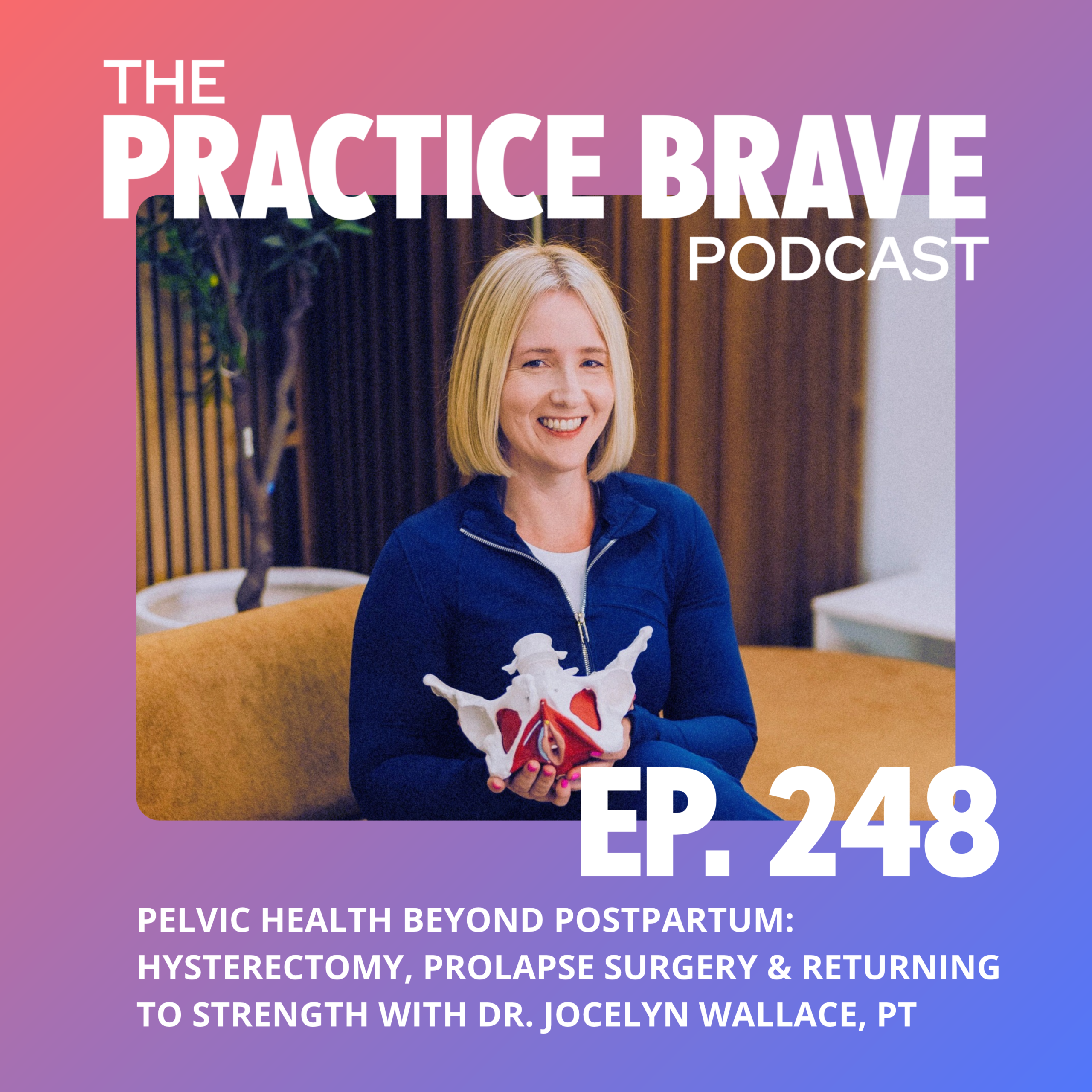
Pelvic health is a conversation that needs to extend far beyond pregnancy and postpartum. In this episode, I sit down with Dr. Jocelyn Wallace, pelvic floor physical therapist, strength coach, and founder of Woven, to explore how pelvic health continues to evolve throughout a woman’s life—and why recovery from pelvic surgeries deserves a more comprehensive approach.
Jocelyn specializes in helping women recover from hysterectomies, prolapse repairs, and other pelvic surgeries, with a particular focus on bridging the gap between surgical recovery and returning to the gym. We discuss why being cleared at six weeks doesn’t necessarily mean your body is ready for heavier lifting, how hormonal changes can influence pelvic health, and why women deserve more than the advice to simply rest and ease back into exercise.
We also unpack the importance of prehabilitation, post-surgical rehabilitation, pressure management, and having the tools to understand how your body moves. Most importantly, we talk about removing the stigma surrounding surgery and helping women make informed decisions that support their health, strength, and quality of life for decades to come.
Connect with Dr. Jocelyn Wallace
- Website: https://www.woven.fit/
- Instagram: @drjocelynwallace
Need workouts for your pregnancy or postpartum? Check out my programs (now with app access!):
The Pregnant Athlete Training Program: https://go.pregnancyandpostpartumathleticism.com/the-pregnant-athlete-program
The 8-Week Postpartum Athlete Training Program: https://go.ppaprograms.com/pp-program
EXPAND FOR EPISODE TRANSCRIPT
AUTO-GENERATED TRANSCRIPT
Brianna Battles 00:01
Welcome to the Practice Brave Podcast. I am the host, Brianna Battles, founder of Pregnancy and Postpartum Athleticism, and CEO of Everyday Battles. I’m a career strength and conditioning coach, entrepreneur, mom of two wild little boys, and a lifelong athlete. I believe that athleticism does not end when motherhood begins, and this podcast is dedicated to coaching you by providing meaningful conversations, insights, and interview topics related to fitness, mindset, parenting, and of course, all the nuances of pregnancy and postpartum. From expert interviews to engaging conversations and reflections, this podcast is your trustworthy, relatable resource for learning how to practice brave through every season in your life. Hey, everyone! Welcome back to the Practice Brave podcast. Today, I’m here with Dr. Jocelyn Wallace, and we’re going to be talking about hysterectomies and how pelvic health experiences happen across the lifespan, not just pregnancy and postpartum, and how so much of this conversation is really interconnected. So, Jocelyn, thank you for being here.
Jocelyn Wallace 01:07
Yeah, thank you so much for having me. Huge honor.
Brianna Battles 01:10
Absolutely. So, give us a little bit of your background and what you do.
Jocelyn Wallace 01:15
Yeah, I’m a pelvic floor therapist who founded a company called Woven, where we exclusively help in getting women recovered from all the pelvic surgeries that don’t have to do with perinatal stuff. So hysterectomies, prolapse repairs, all the stuff that typically happens post reproductive years, and getting them fully back to the gym. My background is as a doctor of physical therapy, but even more than that, a strength coach. I’ve been in the strength industry and barbell sports for longer than I’ve been a physical therapist, and that’s the bridge that’s really missing after these surgeries is getting women fully back into what they love to do. Absolutely. So you see mostly women who are done having babies, and then they end up in your office. Can you tell me like some of the reasons you might see them. Are you seeing them like before hysterectomy or like after or both? Where are you at? So we have a three-month program called the Complete Comeback. It’s completely virtual because it’s like so specific. The women that we work with in our perfect world, they’re in touch with us and they’re joining our program before they even had surgery. But it’s about 50-50 as far as the people who are joining before surgery. In contrast to the people who we catch post-surgery when they’re not feeling the way that they hope to, so we work with a lot of folks that have surgery. Everything goes smoothly, and they’re with us to help to build the bridge back to strength training. Where like they’re offloading the mental load, they know they’re taken care of, and they don’t, you know, they they’re not waiting until they have complications. And then about another 50% of the women that we work with are have had a secretomy or similar surgery. They think everything is, you know, going to go smoothly because that’s often how the surgery is sold. And now they’re not feeling the way that they want to in their training, and they come to us to help troubleshoot that. Got it.
Brianna Battles 03:00
And I want to like before we go into some more specifics, can you explain what a hysterectomy is and why someone may choose or end up needing a hysterectomy?
Jocelyn Wallace 03:12
The hysterectomy is the removal of the uterus. The most common kind done is called a total hysterectomy, which a lot of people there’s still a big misconception that people think that means the removal of the ovaries and that it’s going to kick you into menopause, but total hysterectomy just means removal of the uterus and the cervix, and then they close up the top of the vagina and that is called a vaginal cuff. That’s the most common form of hysterectomy done, but then there’s other forms as well. The most common reasons people have hysterectomies are benign conditions like fibroids, endometriosis, which a hysterectomy is not a cure for endometriosis, but it’s often a part of the plan of care. A condition called adenomyosis. Then we’ve got things like sometimes it’s done alongside prolapse repair surgeries, sometimes it’s done alongside cancer surgeries or because of cancer. Got it. And
Brianna Battles 04:00
in terms of like you say, you work with not just hysterectomies, but with prolapse surgeries. Which I know there are many women who do have birth injuries who do opt for surgery. So can you talk a little bit about what that surgery looks like?
Jocelyn Wallace 04:12
Yeah, it depends on what kind of prolapse the person has. So they’ll repair different parts of the pelvic floor depending on if they have erectocell or cystocele. Both sometimes they leave the uterus, sometimes they remove it because they have uterine prolapse, and there’s mesh repairs, there’s non-mesh repairs where they just use the native tissue. There’s so many different options out there, but the thing that is really missing are return to sport protocols after that surgery, especially, and that is a gap that I’m super passionate about, Philly.
Brianna Battles 04:44
Yeah, that’s why I’m so grateful to have you on this podcast because you know we, the I think the cornerstone of my brand is a lifetime of athleticism, and pregnancy and postpartum are these catalyst seasons where I think so many women are oftentimes, especially our female. They get humbled at some point in the process. At some point in their first birth, second birth, third, they’re they’re experiencing changes to their body. They understand what their pelvic floor is, oftentimes for the first time. But these seasons are also sort of set us up to be more informed about what our body is going to experience long term. Because I know a lot of the women you end up seeing have maybe been managing some symptoms or some something since postpartum, but haven’t necessarily had the kind of support and guidance rebuilding postpartum until you know, like we kind of talked about before, this like something goes wrong, or now they’re in the doctor’s office for surgery, or they’ve had the surgery and it’s having to go back and sort of look at what the last decade plus has looked like for them.
Jocelyn Wallace 05:46
Yeah, absolutely. A lot of the time, we’re the first coach. A lot of the women we’ve ever worked with have you know ever encountered, and they’ve often been through a roller coaster of like they were postpartum, they had some prolapse symptoms, they went away. It’s been 1015 years, and they thought everything was fine. Now they’re having a hysterectomy. Their hormones are, you know, thrown a little off by the surgery. They’re in perimenopause, and it’s like the perfect storm to like that’s the last straw. And now their their prolapse is more symptomatic than ever, and then they’re ending up in the you know ending up having surgery. So they’re often they’ve never been through a progressive strength rebuilding program a lot of the time.
Brianna Battles 06:26
Yeah, and sometimes it feels unpopular to acknowledge that piece of it. Like you know, sometimes a lot of the female athletes I work with are kind of in the mindset of like, well, it’s not that big of a deal if I pee, or it’s not that big of a deal if I’m ignoring this symptom, or you know, I feel a little something, but it’s hard for them to want to address it initially because you’re kind of in survival mode during pregnancy or postpartum, or then like repeating. But really, it’s setting yourself up then for what the future holds as perimenopause comes along, as menopause comes along. When there’s just that added layer, like you said, that final straw of
Jocelyn Wallace 07:00
hormonal changes that aren’t always easily managed, especially through the lens of pelvic health. I think something that the pelvic health industry still hasn’t fully wrapped its its brain around is that we’re not giving women a complete warning about the way that pelvic health symptoms can start to rear their head again when you go through something new like perimenopause, like having hysterectomy, like you know, it’s just the later years and stuff, and like years of training accumulates. But we don’t do a good job of warning people like this might come back. This is what to do if it does. These are the things that you should consider exploring. And so much of the information we’re starting to consider as common knowledge these days, 10 years ago, was not that like vaginal estrogen and tissue changes down there and all that kind of stuff.
Brianna Battles 07:48
Absolutely, I know the conversation around perimenopause and menopause has absolutely boomed over the last couple years, even. But you’re right; there’s so many women that are sitting that stills like don’t know. We’re also like an echo chamber, I think, on social media. Whereas you and I both know, like the general population is like, what? Like it’s all new news to them. Even though on our little bubble of social media, talking about pelvic health, hormones, and all of these things, it’s a lot. It’s I don’t know. It’s more general knowledge on social media.
Jocelyn Wallace 08:20
Absolutely. I was on a podcast recently, and the host asked me, “This is called the labia, right?” I was holding up my pelvic model that I always have with me. She’s like, “That’s called the labia, right?” And I was like, “Oh, like I, we forget how much people need to be taught about their bodies and how little education we get as women about these things.”
Brianna Battles 08:36
Totally, there’s so many women that I work with that you know they’re they’re basically postpartum, and that’s when they’re learning about their body because something doesn’t feel right. And like, well, what am I actually looking at down there? Um, you know, and I’m like, you know, I’m just a strength coach. Like, this is not my this is not the realm I thought I would be talking about. But it’s so true because we we haven’t really been taught about our anatomy and you know the what to expect when you are expecting when you are postpartum, when you are having symptoms that is left out of the conversation. I think a lot of ways because it doesn’t. It sort of seems like a buzzkill, like it’s disempowering to acknowledge like there’s a variety of experiences that can happen. It’s not just all like, hey, you’re really fit. You’re young. You’re healthy. You’re just easy, straightforward pathway. It’s just not always that. So I think sometimes it you’re like going against the narrative when you acknowledge that there’s a lot of different experiences that women have during pregnancy, postpartum, and then long term.
Jocelyn Wallace 09:38
Yeah, and we very much do the same thing post hysterectomy, and that it’s really marketed as a minimally invasive surgery because we’ve made such huge strides in using these laparoscopic and robotic tools that do make the incisions so much smaller. But it’s really not giving credit for the fact that you’re having your uterus removed, the top of your vagina closed up. Most of the time these days, they suspend. The vaginal canal to the ligaments in the pelvis. It’s a permanent anatomical reconstructive surgery to the pelvis, and then women are just told to ease back into it. And we’ve done an incredible job starting that conversation around postpartum in the sense of like there’s so much more available to us than just easing back into it. And that conversation is just barely started in the on the hysterectomy side of things.
Brianna Battles 10:23
Yeah, you’re so right because it changes how somebody manages pressure, or if there’s somebody who like bears down a lot when they exercise. That whole anatomical structure is now different. It is new. That is, there’s been some change, and so maybe if what they were doing before when they were lifting was fine or good enough. Now the their entire anatomical structure has been shifted. So talk to me a little bit about that experience for women.
Jocelyn Wallace 10:49
Yeah. So the biggest thing I see in lifters and athletic women is the suspension. So the vaginal cuff being suspended to the ligaments in the pelvis changes the way that they are executing a lot of their lifts, and it changes the length tension relationship in the pelvis. And we know from all kinds of other research that when we’re cleared at six weeks, the wounds are healed. That doesn’t mean that that tensioning system and the suturing of the vaginal cuff to the ligaments in the pelvis. That doesn’t mean that’s ready to accept the pressure that happens on a back squat. So some of the things we see when people are told to just ease back into it, especially when they’re athletic and they’re easing back into, you know, more than 10 pound dumbbells in their living room, they get symptoms like tailbone pain, pelvic floor tension stuff. Sometimes they’ll say that they feel unstable, weird, like they just don’t feel safe under the barbell. In in barbell examples, and we’ll often see that their control of their pelvis changes. Like they’ll have a hard time bracing and staying in that like ribs over pelvis position, and they’ll get a butt wink or a posterior pelvic tilt, and like the whole tension relationship has shifted. People often also have a really hard time with hinging, especially because the pelvic anatomy has been reconstructed.
Brianna Battles 12:07
Yeah, no, it’s so interesting because you think about that. It’s like, well, like hinging, you’re having to lengthen the pelvic floor, but when you are guarding, even subconsciously, there’s like that protection of like extra tension that our body creates, and that the muscles and everything around that pelvis essentially is trying to create so much support and stability because there’s not like trust there yet from that healing, and it that does absolutely influence movement. Similar to how we talk about helping our postpartum athletes or athletes with symptoms with like prolapse, like how are you moving your body with a prolapse? It’s not that anything is unsafe. It’s like how it’s performed and what you’re doing in terms of like guarding or whatever, because there’s a protection mechanism that’s just so neural.
Jocelyn Wallace 12:52
And then when they feel those things, it’s understandably scary. They go to their surgeon. That’s the surgeons right now are still so discouraging around pelvic floor therapy, post hysterectomy, so they’re these women are falling, and there’s no no system there to catch them, and then they get fearful of exercise, stop lifting, or think they need to dial back because of their surgery, and that just has such a cascade effect of other impacts from like becoming more deconditioned, being afraid of lifting, pulling out of doing things like jujitsu because they’re afraid of those higher intensity sports and it can really have a really long term damaging impact. When all that person often needed is a little bit of reassurance, a little a plan to get back into the movement patterns and understanding of what happened to their bodies, so that they can restore those movement patterns. It’s just a few weeks process a lot of the time, and then feel comfortable with a heavier lifting and harder workouts.
Brianna Battles 13:47
Absolutely, and I I think it’s interesting that you said that a lot of the surgeons are not referring to pelvic floor physical therapy after after these surgeries.
Jocelyn Wallace 13:56
Actively discourage it in a lot of cases. Unfortunately, it’s getting better. There’s some surgeons who prefer, but
Brianna Battles 14:02
why is that in your opinion?
Jocelyn Wallace 14:05
I think they’re just taught in their curriculums that it’s a minimally invasive surgery, and that it’s no big deal. The incisions are small; it doesn’t directly disturb the pelvic floor muscles. Like they don’t cut the pelvic floor muscles. Yeah, like for and they also don’t cut the abdominal muscles. So I had a surgeon tell me one time, we don’t cut the abs; we just go through the fascia. So why should people have therapy? But they don’t stop to consider everything that the guarding responses and everything you just you just mentioned, but also everything that happens to women before they make the choice to have a hysterectomy. Yeah. So for example, I’ve had 60 fibroids removed, three open abdominal surgeries before I had my own total hysterectomy, and that the trauma that my pelvis has been through, and the the swelling and the carrying of masses for a decade of my life, like that did something to my body, and just that process deserves a rehab process. Even though the surgery was successful, in my case, it was uterine fibroids. To remove the uterine fibroids, there’s still a rebuilding process that has to happen. I had to reconnect with my deep core. I had my pelvic floor had a lot of tension that I had to work through, and that kind of stuff. It’s not just snip it out and get back to. Yeah, you’re so right.
Brianna Battles 15:19
I think we really underestimate like the impact that even just like straightforward, like straightforward laparoscopic surgery can have on just our anatomical structures from the inside. It’s like maybe it is minimally invasive, but our body is still having to adapt and heal from the inside out. And when you can’t like physically see it, I think sometimes there’s a little bit of a disassociation there with like really understanding. Oh, this needs to heal. This is different, you know. Like your body hasn’t dramatically changed like it does in pregnancy. Where okay, this is maybe a little more obvious or postpartum. You got a lot of different variables going on that sort of keep you keep you where you’re at. I think with a lot of these other surgeries, you’re told, “Well, just get this, and it’s going to fix this problem, and then you’re going to be all good.” Like that’s why they, you know, a lot of these surgeries are are positioned that way. Is this will fix your problem,
Jocelyn Wallace 16:14
and it often does. But there’s little thought given to the what the problem was and what problems that problem created, and the deconditioning women are going through before surgery. Sometimes people have been out for a year, ages more than that because of whatever they were going through symptom-wise before. Especially in in women who have endometriosis and all the ups and downs that they experience. And then to give someone the longest surgery I’ve worked with was a 12-hour surgery, and to give that person the same rest six weeks and ease back into it as a person whose hysterectomy was for a relatively mild situation and took an hour. Some of these surgeries are very quick, and like you’re home a few hours after surgery, those are two vastly different things, even though they’re coded and labeled the same, and they’re both getting the same advice about recovery.
Brianna Battles 17:03
Yeah, that is really it is wild. Um, one of my good friends had a lot of surgeries attached to unfortunately having colon cancer, and she just she she knows a lot about the work that I do. She actually worked with me for a long time, and you know she just was saying like pelvic floor physical therapy needs to also be part of the surgeries that so many of us like cancer patients are having with our colonoscopy and it’s just not part of that conversation. Just being able to even just reconnect to that system again because of all the trauma from surgery and all of the scar tissue that she had acquired, and it was just like a really eye opening conversation. That again, like so much of what we create awareness around during pregnancy and postpartum translates to so many different people that we’re going to work with. You know that all of what these women are going to experience at some point in their lifetime, you know they they may experience, or just that general education around there is support for your body after all of these, you know, potential surgeries or disease and things like that, I think it’s really easy to overlook that.
Jocelyn Wallace 18:10
Yeah, yeah, absolutely. And I want to see the same kind of revolution that’s happened to postpartum care happen for all of those surgeries too. And there’s vastly different, like to bring up cancer, the the techniques used in a surgery for uterine cancer vastly different experience than people having a laparoscopic hysterectomy for a few fibroids. Two totally different experiences. The incisions are often in different places. The postoperative experiences will often be very different, given the same advice,
Brianna Battles 18:41
absolutely. So, what does like some of your framework look like when you have somebody who’s come to you and they’ve had a surgery? Um, let’s just say a hysterectomy for whatever reason. What what are some parameters that you’re looking at as a practitioner and helping them get back to exercise?
Jocelyn Wallace 18:58
Yeah. So, the first consideration that we’re making is how much intra-abdominal pressure they’re ready for. So we work all virtually. So we use a Zoom call to be able to look at how their abdominal wall is lengthening, how it’s contracting, and every position that’s appropriate for them. So if appropriate, we’ll do it standing up. Most people it it is appropriate, but we’re doing it standing up, lying down, all the positions. And then we have a series of four tests that we do. We call them level one through four, and we work people through these levels. And then, depending on which level they show that they’re not able to tolerate intra-abdominal pressure any further, then that helps to dictate like, should you start doing your laundry? Should you start doing this? Like, we give people a full understanding and full clarity about what their post-op restrictions should be, instead of just don’t lift 10 pounds or you know don’t lift a gallon of water or whatnot. But our the first basis is how much abdominal pressure they’re ready to handle, and then that dictates what exercises they can start with. So most of the folks that we work with. Are able to start within a week or two of surgery with some upper body strengthening and stuff. Sometimes some split stance and single leg and lower body stuff is like the average of where people are able to start based on their abdominal testing. And then they get into that part, and then we start considering the like the cleaning up of what was going on before surgery. So, in the case of large fibroids, for example, there’s often a lot of restriction around the hip. There’s some movement stuff that’s come up because of the way they’ve learned to move around, having large masses in their pelvis. So, we’ll start with like some mobility and some undoing of those things.
Brianna Battles 20:37
Yeah. Oh, absolutely. And just like all like how they learn to manage pressure or tension prior, and then, or if they did at all, you know. Honestly, I know we try to say in like my world is if you have prolapse, even if you’re if surgery might be your option or a really significant diastasis, and surgery might be the pathway you’re going down, you’re going to give yourself a significant head start into surgery if you can sort of prehab and have a better understanding of your body and pressure management and tension and just like how to adjust some of your movement patterns for managing your current symptoms, even if surgery is going is like something that a path that you’re going down because it will help you so much post op.
Jocelyn Wallace 21:18
Yeah, absolutely. I think it’s also appalling how we’re like doing diastasis repairs and prolapse surgeries and not giving women any of these tools. And like prolapse repair surgeries have the reputation of having a high recurrence rate. I think it could be a completely different world if women were given the tools to understand pressure management and stuff and be able. We call it yellow and red flags. Be able to recognize their yellow flags and know how to adapt their movement patterns. Like a common one, we give people a lot, and people that it’s usually amongst women that have had a more severe situation, more deconditioning, a lot of stress and trauma to the abdomen. They’re often not ready to like stand on two legs, squat down, bend over, do some of those higher pressure positions at first, so we’ll have them adapt to a split stance to do their activities, and that can be a tool that a woman healing from a prolapse repair can use for the rest of her life. Where she starts to feel yellow flags, pelvic floor fatigue, she has that tool to be able to switch to a new position in her gardening, or to know that she should modify her overhead press to a split stance, strict press, and we don’t give anyone those tools. And then we say that the surgery has a high recurrence rate.
Brianna Battles 22:30
Yeah, I think that’s such a such a good point with the high recurrence rate because I’m and please like correct me if I’m wrong. Like so much of those the need for a corrective surgery, or why they quote fail, is because there’s a lot of pressure being down, and it’s not being like absorbed by that surgery that was performed. Correct.
Jocelyn Wallace 22:51
I think that’s a big part of it. I think another part of it is the depends on when someone had their surgery and what advice they were given. So their surgeon still it was this was much more common long ago, but there was there are still surgeons who tell women who’ve had a prolapse repair to never exercise again. So then, what impact does that have on her tissues? Like literally, her tissues are now becoming more frail, more deconditioned, more prone to failure. To like paint the picture of how this can happen, the most the woman with the most prolapse repairs that we have worked with was five, so she had five prolapse repairs over a 1520 year period. Started 15 to 20 years ago, so it was much more common back then for women to be told to never lift, never exercise, never try to work out. So she was a victim to that advice. Kept having failures. Now she had a more modern surgery with a pro-exercise surgeon who has read the up-to-date guidelines that show that outcomes are better when women have early mobilization, when they strength train, when they. We have no evidence to support the idea that women shouldn’t lift weights after pro-lapse repairs. So she had a surgeon who was reading the literature who encouraged her to get back to exercise, who encouraged her to work with someone like us to work with pelvic floor PTs, who can get her back to things. She’s jumping on a rebounder, lifting weights, super fit, able to take care of her grandbabies. As of now, a few years after surgery, hasn’t had any recurrence. I think in a story like that, it could have been different if she was given advice like she has been now, 1520 years ago,
Brianna Battles 24:24
yeah, because that deconditioning is is so real, especially kind of assuming she’s you know a lot of that was during hormonal shifts in her life of perimenopause and menopause, at least across the span of her getting those repetitive surgeries. It’s really interesting you’re bringing this up. I actually just last week talked with a P and P A coach, and she was saying that she had somebody in her in her gym that she was coaching at who had I don’t know the exact surgery had, but a surgery on her urethra, and the surgery quote didn’t work because she was still peeing when she was lifting heavy, and so this woman was so discouraged. And then when one of these like the coach who went through my certification was able to work with her, she’s like, “I just changed some of her breathing strategies and how she was bracing, and now she’s not peeing anymore.” And she’s going like, “Wait, like this is a surgery. I went in to get surgery for this exact problem, but really the whole time maybe I just needed to do X, Y, or Z, and it’s hard to like look at things like that. But I think there’s so much value to these worlds coexisting.
Jocelyn Wallace 25:27
Yeah, I have a very coach first mindset. So if someone is having symptoms with a movement, the first thing I want to do is explore the movement and see if they’ve been taught how to brace, if they’ve been taught how to breathe with the movement. Explore the movement. There are women who have been on the pelvic floor therapy hamster wheel, the urogynecology hamster wheel for years, and no one has just looked at them squat or asked what movements are symptomatic and looked at the way that they’re jumping rope or taken that full body approach. And it just absolutely breaks my heart because sometimes it is as simple of a fix of just addressing the symptomatic movements and addressing the the pressure management.
Brianna Battles 26:06
Absolutely, yeah. Again, it comes back to like we are in such a echo chamber on social media where we’re like, yeah, like these pelvic floor physical therapists they’re practicing like this, and we’re like we’re all sort of movement biased. But again, the reality is that is not necessarily in every community. That’s not how every pelvic floor physical therapist or physical therapist in general works. Like where they’re looking at that like more performance based, fitness based, lifespan based approach.
Jocelyn Wallace 26:36
Yeah, that’s very much not not what’s happening out in the real world, unfortunately.
Brianna Battles 26:41
Well, especially I think through the lens of like hysterectomies, because there’s also I feel a taboo or a stigma around that hysterectomies are only for like old ladies, and so like they’re not really ones who are going to be exercising that much anyway. Like that’s sort of a very common belief system, but I’m sure you can attest there are women of all ages and all backgrounds and all considerations that are having pelvic health surgeries, not just old age.
Jocelyn Wallace 27:09
Yes, absolutely. The youngest clients we work with are in their 20s. Usually, they’re having hysterectomy for very extreme endometriosis-related situations. But we work with women all across the lifespan. We also work with a lot of super fit women in their 60s. Like I recently graduated someone who was a six pack. She shredded. She’s 64. Had her hysterectomy, and what she wanted was to not have to go through being treated like an old lady just because she had a hysterectomy. Like she was someone who was super fit. She was ready to do a whole lot of exercise a week or two after surgery, and it was really just about holding her back while also making sure that she didn’t unnecessarily lose fitness. Because women like her are often put into the system in a way that they’re using fitness, losing muscle mass, losing the six pack they work so hard for for no reason, because they’re just treated based on like what the age says on our paperwork,
Brianna Battles 28:01
yeah, that’s so true. I think it’s probably really fascinating to see like the differences across like all the different, I guess, types of people that you work with, or even like the different types of surgery.
Jocelyn Wallace 28:12
Absolutely, and the things that um very much correlate with how surgery goes, like definitely being fitter, people who have more fitness, more muscle mass, especially around the abdominal wall, seem to recover quickly. They’re usually the ones that are like the the outliers and just feel perfectly normal. I think I think likely that has to do with literally you add more blood flow to the healing tissues when you have like a beefier rectus abdominis and just beefier muscle around there. Yeah, they often are the ones that that soar and fly.
Brianna Battles 28:42
Yeah, that’s that. I like that point. That there’s a like even just like that blood flow for healing is such a big part of it. It’s not just strength, or it’s not just like a body fat percentage. It’s more of like the muscle tone and that circulation that helps fuel the recovery.
Jocelyn Wallace 28:58
And I would imagine if we would do a research study on how the pelvic floor, like hypertrophies with exercise, which to my knowledge has never been done. I think we would find something similar in that women who do who know what hypertrophy means and apply it to their body have better outcomes after these kinds of surgeries because their pelvic floor is also like more vascular.
Brianna Battles 29:19
Absolutely. So, what advice would you have for somebody who’s they’re maybe in their 30s and they’re managing a prolapse? Surgery is something that’s been mentioned to them, but they’re like, I don’t know if I necessarily want it or need it, and they’re living in that land of like uncertainty about the future. What advice would you have for them?
Jocelyn Wallace 29:38
I would make sure that they’ve stopped to consider the impacts of, however, their prolapse is limiting them, and remind them that the number one killer of women is cardiovascular disease. I say that all the time because we’re often not taught to consider the impacts of not being able to exercise the way that we want to. So, if someone’s symptoms are getting in the way of their ability to do. Cardiovascular exercise to maintain their muscle mass. If they can feel that frailty and that deconditioning starting to set in, or if they hopefully have a DEXA scan in their records and know how how things are going there, we’re not we’re often not counseled to consider that loss of fitness. And if having surgery creates the path for you to get your fitness back, that can be absolutely life saving. Yeah, and we’re not taught to consider those things at all. Yeah, no, I think it’s just a fascinating
Brianna Battles 30:30
conversation because it all does come back to like how informed are we, and then how proactive are we? Not just for like where we are right now, but really thinking of that longevity aspect. I think we’re, you know, there’s like bone health is in the media. We know, like, okay, we need to be lifting weights so that we are strong as we enter perimenopause and menopause, and being like lift heavy weights so that we can have more muscle mass and again bone health and understanding more about hormones and how that affects affects so many different variables, but pelvic health definitely needs to be part of that conversation for women, where we’re we’re doing things proactively now in our younger years, or maybe before there’s symptoms, or while we’re we’re working to manage and work within the constraints of symptoms, so that as we age, you just feel more informed. You feel like you know what your next right step is because so many women are like, I didn’t know this was a thing. I didn’t know what to do. I don’t know like what the next steps are, and then they go through that arsenal of
Jocelyn Wallace 31:30
a a lot of visits with different doctors and pelvic floor physical therapy, and it’s just very confusing. Yeah, and everyone’s in their silo and just giving the advice that will help prevent that one thing. Like in the example of prolapse, they’re going to their doctor, their pelvic floor therapist, and they’re getting the advice that will help the prolapse symptoms. But no one’s stopping and zooming out and thinking, “How is her overall health going? Is she able to engage in the bare minimum physical activity guidelines?” So many women are living with prolapse and not able to because of their symptoms, and I think they deserve informed consent about you know these are the things we can do to manage your symptoms conservatively, but you’re going to have these limitations, and these are the risks of those limitations. And then on the surgical side or the pessary side or whatever tool is available to them, this is how that tool could open up the window for activity, and this is the benefit that you could get from being able to meet those activity guidelines and do things you want to be able to do.
Brianna Battles 32:25
Yeah, absolutely. Expanding that conversation. I mean, it’s. I think that’s what’s actually like holistic women’s health and like having like that biopsychosocial like model implemented in a lot of different environments. You know, so it’s like medical practitioner coach slash fitness side of things, we’re we’re able to integrate all the different considerations because I think so many women are just confused about their body, and they go off of what their friend said or what maybe their mom experienced instead of what is working now or what’s needed now in 2026.
Jocelyn Wallace 32:58
What we know, and we’re not yeah, and we’re not taught about what a like our 30s, our late 30s, early 40s is really the last chance for it to be relatively easy. It gets a lot more challenging after that for building muscle, for recovering osteopenia and improving bone density. Gets a lot harder in your 50s, in your 60s. It’s really our last chance, and if we’re spending that time managing pelvic health concerns because of postpartum and limiting our activities to keep our symptoms low. Like I think we’re really doing women a disservice when we don’t paint that full or multi-decade picture for them, so that then they have the choice. And if it’s their choice to not engage in strength training because it helps to manage their prolapse symptoms. That’s, I think, that’s a valid choice. But sometimes surgery can be an incredibly empowering part of the story. And I’ve worked with a lot of women in their 50s and 60s who lived with prolapse for 30 years and deeply regret it and deeply wish that they would have had surgery sooner, but they put it off and put it off, and there’s also so much shame in the pelvic health industry around surgery. A lot of pelvic floor therapists are very anti-surgery, very anti-hysterectomy, very you know do everything at all costs to avoid a prolapse repair, and a lot like we can be with joint replacements and stuff like that, which is a whole other thing. Like, but there’s a lot of like anti-surgery shame in that space, and there’s not a lot of people speaking to the opposite that surgery can be a life-giving thing, and it’s incredibly safe.
Brianna Battles 34:33
Yeah, I think that’s like a really good point because you’re right. There is a lot of like almost like dogma around surgery or further intervention, or things that are not quote natural, and just the messaging that we hear and how that plays into someone’s relationship with their body, or what, especially like our very health-minded people, like what that now means for them. A lot of layers to that, and I think that so much of that messaging comes from a. Well, it’s gonna like this. These surgeons have a high failure rate anyway, but I think like what you said is so true. With but if you’re going into it with improved like now almost like prehab and that knowledge, and then post op, you’re not just winging it. You’re working with somebody like yourself. Then we’re really reducing your risk of you know needing to have another surgery down the line,
Jocelyn Wallace 35:21
yeah, absolutely. And like, as someone who’s had a total hysterectomy, if I I had a hysterectomy, I was 34. I’m 36 now. If from 34 to 44, I can train my butt off and get really, really strong. And like, I’m fitter and stronger than I’ve ever been. I need more pull ups than I’ve ever been able to do before. Like, my training is going so much better. If I could get a decade under my belt, but then I develop a recto seal in my 40s, which can be a risk of hysterectomy, I would take these 10 years and get a recto seal repair. I would like gladly accept that part of the story, which I know can come from you know a lot of bias as a professional who knows who would know what to do if that were to start to happen to me, but I would not give those 10 years for anything. Hopefully, that doesn’t happen. Yeah. Well,
Brianna Battles 36:07
you’re you’re getting that like net win of like you’re building muscle, you’re improving your cardiovascular fitness, you’re improving your bone health, you’re kind of getting as much as you can out of these formidable years as you’re going into the next chapter,
Jocelyn Wallace 36:24
yeah, and it’s the same with like diastasis repairs and stuff. Like, how many women are doing these deep core programs, underloading their body generally while they try to manage their diastasis, quote unquote, naturally? When I could just get that thing, I’ve also had a abdominal plasty since my hysterectomy, if I could just get that thing managed and then train hard, like that has a a benefit side.
Brianna Battles 36:48
Absolutely, I think it’s just it’s destigmatizing what I like. I guess I refer to it as like you have choices and you have circumstances, and sometimes you have a messy middle between those two. And I think that surgical route by choice or circumstance. This has to be part of the conversation without shame or judgment or dogma, because that really gets in the way of supporting a woman’s lifetime of athleticism. Like everyone’s story and journey looks different. What are we doing to help that woman have the highest quality of life? Whatever that looks like for her, even if it’s different than what I would choose. It doesn’t matter. Like as professionals, we just have to help. What, like basically, zoom out of any stigma and zoom into what’s going to like help all these different categories of her life.
Jocelyn Wallace 37:32
Yeah, absolutely. And we ask people all the time, like, what are your fitness goals, and you know, what do you want to achieve in the next decade? And they’re like, I hired you to help me with my hysterectomy recovery, but no, I want you thinking big picture because so many people have never brought that up, and they’ve been to so many appointments and gone through so much to get to surgery, and then no one’s ever asked them like what they want for the future through that decision. Yeah, and that you know bringing that up can highlight so much in the decision-making process,
Brianna Battles 38:01
yeah, absolutely. Well, Jocelyn, I really appreciate the work that you’re doing. I think you’re an incredible resource for women navigating these seasons of surgery, of pre-surgery, post, all of the different things. And I think a really solid resource for a lot of women who feel like they don’t have resources and they don’t have insight. So, thank you so much for coming on this podcast.
Jocelyn Wallace 38:22
Yeah, thank you so much
Brianna Battles 38:23
for having me. Absolutely. Where can people find out more about your your services and just follow along with you?
Jocelyn Wallace 38:30
Yeah, the website is woven dot fit. W O V E N dot fit, and then I’m the most active on Instagram. My handle is Dr. Jocelyn Wallace. Awesome. Well, thank you so much for coming on the podcast. We appreciate you. Yeah, thank you.
Brianna Battles 38:47
Thank you so much for listening to this episode of the Practice Brave Podcast. If you enjoyed the show, please leave a review and help us spread the work we are doing to improve the overall information and messaging in the fitness industry and beyond. Now, if you are pregnant and you are looking for a trustworthy exercise program to follow, I have you covered. The Pregnant Athlete Training Program is a well-rounded program for pregnancy with workouts for each week that are appropriate for your changing body. That’s 36 weeks of workouts, three to four workouts each week, and tons of guidance on exercise strategy. We also have an at-home version of that program. If you are postpartum and you’re looking for an exercise program to follow, the eight-week postpartum athlete training program would be a really great way to help bridge the gap between rehab and the fitness you actually want to do. From there, we have the Practice Brave Fitness Program, which is an ongoing strength conditioning program where you get new workouts each week and have a lot of guidance from myself and my co-coach Heather Osby. This is the only way that I’m really offering ongoing coaching at this point in time. If you have ever considered becoming a certified pregnancy and postpartum athleticism. I would love to have you join us. Pregnancy and postpartum athleticism is a self-paced online certification course that will uplevel your coaching skills and help connect the dots between pelvic health and long-term athletic performance, especially during pregnancy and postpartum. Become who you needed and become who your online and local community needs by becoming a certified pregnancy and postpartum athleticism coach. Thank you again for listening to the Practice Brave podcast. I appreciate you, and please help me continue spreading this messaging, this information, and this work.
MORE ABOUT THE SHOW:
The Practice Brave podcast brings you the relatable, trustworthy and transparent health & fitness information you’re looking for when it comes to coaching, being coached and transitioning through the variables of motherhood and womanhood.
You will learn from athletes and experts in the women’s health and coaching/performance realm as they share their knowledge and experience on all things Pregnancy & Postpartum Athleticism.
Whether you’re a newly pregnant athlete or postpartum athlete, knowing how to adjust your workouts, mental approach and coaching can be confusing.
Each week we’ll be tackling questions around adjusting your workouts and mindset, diastasis recti, pelvic health, mental health, identity, and beyond. Through compelling interviews and solo shows, Brianna speaks directly to where you’re at because she’s been there too!
Tune in every other week and share the show with your athlete friends!
This post may contain affiliate links, which means we receive a small commission from the seller if you decide to purchase (at no additional cost to you!) We only share products and services we have used, tested, and love ourselves!