
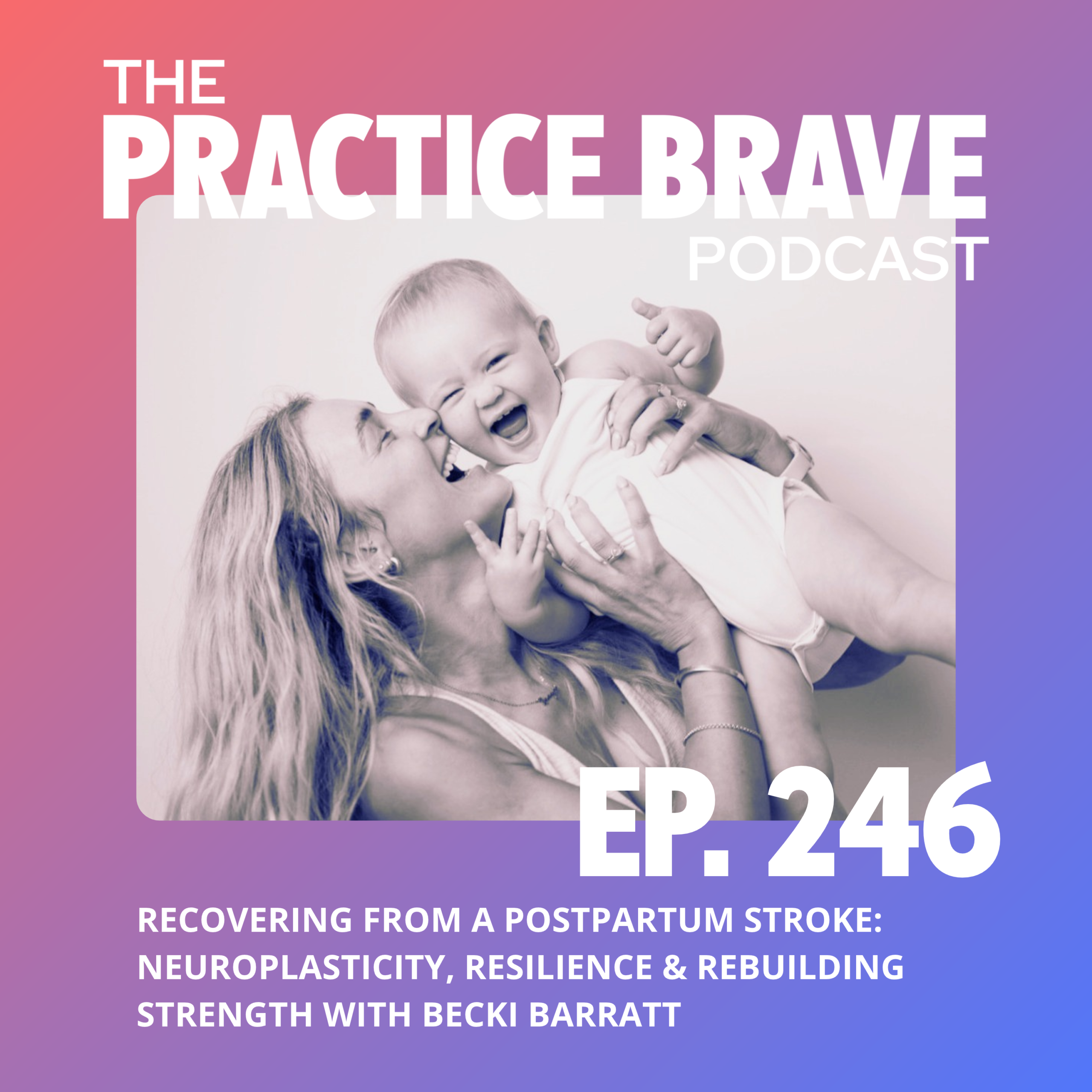
In this episode, Becki Barratt shares her powerful journey of recovering from a stroke just three weeks postpartum. We discuss the physical and mental challenges of navigating stroke rehabilitation while caring for two young children, and how her background in strength and conditioning has shaped her approach to recovery.
Becki explains neuroplasticity, the importance of early intervention and consistent movement, and how tracking small wins can help you recognize progress when recovery feels slow. We also explore the impact of stroke on postpartum recovery, pelvic health, identity, and mental well-being.
Her story is a reminder that progress doesn’t always look the way we expect, and that even when life changes dramatically, there are still ways to adapt, rebuild, and move forward.
Connect with Becki:
- Instagram: @beckibarratt_
Need workouts for your pregnancy or postpartum? Check out my programs (now with app access!):
The Pregnant Athlete Training Program: https://go.pregnancyandpostpartumathleticism.com/the-pregnant-athlete-program
The 8-Week Postpartum Athlete Training Program: https://go.ppaprograms.com/pp-program
Want to become a more confident pregnancy & postpartum coach?
The Pregnancy & Postpartum Athleticism Coaching Certification equips coaches with evidence-informed tools, practical strategies, and the confidence to support pregnant and postpartum athletes through every stage.
👉 Learn more: https://join.pregnancyandpostpartumathleticism.com/ppa-cert
EXPAND FOR EPISODE TRANSCRIPT
AUTO-GENERATED TRANSCRIPT
Brianna Battles 00:01
Welcome to the Practice Brave Podcast. I am the host, Brianna Battles, founder of Pregnancy and Postpartum Athleticism, and CEO of Everyday Battles. I’m a career strength and conditioning coach, entrepreneur, mom of two wild little boys, and a lifelong athlete. I believe that athleticism does not end when motherhood begins, and this podcast is dedicated to coaching you by providing meaningful conversations, insights, and interview topics related to fitness, mindset, parenting, and of course, all the nuances of pregnancy and postpartum. From expert interviews to engaging conversations and reflections, this podcast is your trustworthy, relatable resource for learning how to practice brave through every season in your life. Hey, everyone! Welcome back to the Practice Brave podcast. Today, I am here with Becky Barrett, and I’m excited to talk to her. She has been a strength coach and working in the pre and postnatal industry for a while now, she just had her second baby. But with that came more than just having a second baby. She is currently recovering from a stroke, and we want to talk about her experience as a mom, as somebody who’s been navigating the rehab process in a lot of different ways. So, Becky, thank you for being here.
Becki Barratt 01:22
No, thanks for having me. Excited to be here.
Brianna Battles 01:24
Yeah, absolutely. So give us a little bit of your like background, who you are, the work that you do.
Becki Barratt 01:29
Okay, so obviously Brianna just mentioned that I have had a stroke recently, so I’m now four months post stroke, so recovering from that. But on top of that, I was when I had it three weeks postpartum, so I’ve worked in the health and fitness industry for over 10 years now. So I’ve been very much into all of that. I’m probably what you would have seen a picture of perfect health. So when I had this stroke, when they told me I had a stroke, I couldn’t believe it. So not only was I three weeks postpartum, yeah, it’s just been an absolute killer over the past four months. But I’m recovering well now. I’m running again. So yeah,
Brianna Battles 02:07
yeah. What is your athletic or sport background?
Becki Barratt 02:10
Um, there isn’t really. I’m just very much into strength training. So years and years ago, I was very much into the bodybuilding side of things.
Brianna Battles 02:17
Yeah,
Becki Barratt 02:17
and then that just wasn’t for me. So came away from that, and it’s just been a case of my health and just being as healthy and as I can for me and the kids, really.
Brianna Battles 02:26
Okay. And then, what got you into the pre and post sale fitness? Was it before you had your first baby, or during that time period?
Becki Barratt 02:33
Well, I work with a lot of women, so I kind of dipped my toe in it a little bit before I had Area, who’s my youngest, my eldest. Yeah. And then, when you get pregnant, it’s just so relative, and you just want to learn more and more and more. And I learned so much from you and your Instagram, and just obviously that’s just now is when it’s all come about all the information of it. When I had a rare, it was two years ago now, so there was lots of information out there, but I was still a bit should I, shouldn’t I do that? And I trained all the way through. I was actually did a leg session in the morning. I had a Raya, so I was doing legs at 7am. I pushed her out at 7pm. So that was a that was a big day. And then two years later, got pregnant with my son. And even more information has come out. So it’s just been a breath of fresh air, being able to train all the way through your pregnancy, knowing it’s Safe,
Brianna Battles 03:21
yeah, absolutely, yeah. The industry is it’s changed a lot over the last 12 years that I’ve been in it, and you know we we just see like we’ve normalized women training during pregnancy, and now the research validates how women have been training.
Becki Barratt 03:35
I know, so lucky that we are this generation, not previously.
Brianna Battles 03:39
Yeah, like millennial women have kind of, I think, in a lot of ways, really normalized just training during pregnancy, and it’s not unusual to see that. And now it’s just getting a lot more attention, and just again more normalized, which is a great thing.
Speaker 1 03:54
Yeah.
Brianna Battles 03:55
So with that, obviously we have normalized women training during pregnancy and the benefits of that, and the outcomes postpartum being improved. And so, I think that instills a belief system of like, well, I’m young, I’m healthy, I’m fit, I did everything right during my pregnancy, and talk to me about what postpartum was like for you the second time.
Becki Barratt 04:22
Postpartum, obviously, the first. Well, firstly, when I had my son, we had a traumatic birth. He was shoulder dystocia, so obviously that’s when you push the head out, and then yeah, the body gets stuck. So I had a bit of a traumatic time with that anyway. But we both ended up okay, so that was fine. Um, so postpartum was as it was. Um, I was recovering nicely, and then as I kind of said, I was really the picture picture of health. Um, so one day I was sat on the sofa just downstairs on a Sunday morning. It was really normal. I’d actually got back into training a bit and I’d said to my partner, “I’m feeling really good, considering I’m three weeks postpartum. Like, I do feel good.” And then I was sat. Breastfeeding, and 10 minutes later, I’d had a stroke. So all the first came over me is my hand just went into spasm, and I was just like, just something didn’t feel right. So I just shouted up to my husband. I said, James shouted, and I stood up with my son because I thought I need to get him to safety, like as quick as possible. And then my legs just collapse beneath me, and then I’m shouting my husband. I said, “James, James!” So he ran downstairs, and at this point, I’m on the floor with my son in my arms, and I’m just saying, “I’m not okay.” And he’s like, “What do you mean?” I said, “I don’t know.” I said, “I just don’t feel right.” So he’s asking me to blink. He’s asking me to move this. I said, “I can’t move my. I can’t move my arm. I can’t feel anything.” And then I said, “I feel like I’m having a stroke,” and I felt so ridiculous saying it. But it’s really hard to explain. But everything you imagine a stroke feels like is that. So he was so with that. He was like, “Right, okay.” So he rang 999 straight away, and then the paramedics came.
Brianna Battles 06:00
They took me off on a stretcher, and then I was in hospital for the next week. That is insane thing to process, especially like I said, early postpartum when I feel like we can almost we gaslight ourselves with like, well, there’s I’m sleep deprived, or it’s this, or it’s that, and then your body just goes into that mode, and immediately your life has changed. Yeah, yeah. So, so you ended up in the hospital, and then were you cognizant at all, or were you just like not there? So,
Becki Barratt 06:34
yeah, I was just I was completely knackered. So the stroke had just completely taken out of me, and so ended up in hospital for the five days. So initially, I was breastfeeding. I’m still breastfeeding, luckily. Um, but when you have your CT, you have to have dye put into you to not sure what they actually done. So I then couldn’t breastfeed my son. So I’m paralyzed at this point down my entire left hand side. Um, and I was had to pump and dump for 24 hours, which I’m sure any breastfeeding mum can relate to. That it was absolutely heartbreaking. And just watching. Well, firstly, obviously my husband had to put the pumps on me because I couldn’t do anything. Then watching him pour it down the drain. And then yeah, my son got brought into me after 24 hours, so then I could start feeding him again. My mum would come and take my son home every night because I had to have the rest because obviously that’s crucial with stroke recovery. So it’s pump in the day, send that home with her. She’d bring him back the next day. Um, and then yeah, I think after three days, I took my first steps in hospital. That was with physios, both sides of me. One pulling my leg forward because I it’s insane. I just, it’s mad how we just lose absolutely everything.
Brianna Battles 07:44
Absolutely. So, for those that are maybe not as familiar with what a stroke is, can you explain the mechanism of a stroke, and do you have any idea what contributed, if anything?
Becki Barratt 07:58
So, a stroke is essentially your brain being starved of oxygen. So you’ve got two different causes of a stroke. So it can either be a blood clot or a brain bleed. So when the paramedic took me from my house to the hospital, he said, like, we if you have had a stroke, there’s two options. So it’s a clot or a bleed. If it’s a clot, there’s some great treatment which is called thrombosis, which is essentially something they’ll inject into you, and it clears any blood clots. And he was kind of implying that that’s the better better of the two. And then if there’s a bleed, he said it’s a bit more complicated then. So I’m on the way into hospital thinking, well, I hope it’s this clot. So that’s what I’m banking on. And then yeah, as I said, you so that that clot or that bleed has starved your brain of oxygen, and then depending which part of that brain depends on what stroke severity, what part that’s going to affect ETC. So my stroke was on the right hand side of the brain, which I’m not sure if you were, but your brain, your the right side of the brain is responsible for your left side of the body, and vice versa. So the clot was in my right side, and it affected my movement. So therefore, I was completely paralyzed. I was very fortunate that it didn’t affect speech, swallowing. So a lot of people can be affected by that. So then they’ve got to learn to walk, swallow, all of that sort of stuff again. And but mine was just movement, and it was quite a severe stroke in terms of it was some people just lose a little bit of movement or just a bit of weakness, whereas mine was completely paralyzed. So yeah, they gave me the as I said, there’s the thrombosis if it was a blood clot, and that’s what mine was. And then there’s a yeah, there’s quite a lot of causes for it really. Most of them are going to be if you’ve got high blood pressure, stressful life, basically everything that I’m not. So I’ve got very low blood pressure. I’m not stressful. I exercise. I do all the things that you should do. So on paper, I’m not the person to have a stroke. So currently, I am under investigation. I’ve had all the usual. Tests. So one thing that can be is a hole in your heart. Um. So we’re all born with a hole in our heart, but 25% of us are actually still walking around with that hole in the heart. Most of us it should just close over. So if you have another um thing with that, then that can cause a stroke, i.e. postpartum. So as you know, pregnancy and postpartum, my blood’s much thicker. So if you’ve then got that along with your hole in the heart, then that can be a sign for stroke. However, I have had that test, and there’s no stroke. There’s no hole in my heart, so I’m an anomaly at the moment.
Brianna Battles 10:36
Absolutely. Well, gosh, what a what an incredible story, and the fact that you are able four months later to be here and speaking and speaking like normally. How is your that paralysis on the left side? Obviously, it’s gotten better, but what is it like for you currently?
Becki Barratt 10:55
Well, it’s one of them. So obviously, you know, you you’re an athlete yourself. You have high standards. So for the general population, if you saw me, you’d think I move very well. I’m normal, and I do look walking down the street. You wouldn’t have a clone, but my how I was before, I’m nowhere near there. So it’s amazing how quickly you lose muscle and strength. So we all know how hard it is to build muscle. It is literally so slow. Well, how quickly you move lose muscle is when you aren’t moving a single thing. I’ve just lost such weakness. So I was doing 12 pull-ups before. I can’t even pull myself up once now. But as you said, I’m here and moving, and I’m just building back up from scratch now.
Brianna Battles 11:42
Absolutely, and it seems like they’re so lucky, or not lucky, but just the the fact that your husband was home to find you and be able to to get you the help and resources at that point in time.
Becki Barratt 11:56
No, absolutely. I always say I’m very lucky and unlucky situation. You know, as said, my husband saw me quickly, and so they do say there’s a golden hour towards when you get seen. So if you have had a stroke, every minute that passes, there’s like a million brain cells that die. So obviously, the every minute that passes, the more this stroke is going to affect you. They say there’s a golden hour. So if you can get this thrombosis, which I spoke about before the treatment, within the hour, your severity of stroke is going to be much less. But I always say, gosh, imagine if people have it when they sleep and they don’t realize. So they could, you know, nine hours later wake up and realize they’ve had a stroke. Imagine if it happened when you were driving. I can’t even bear to think about some of the things that it could be. So as I said, a lot of support around me. Where I am now, I am very lucky in an unlucky situation.
Brianna Battles 12:47
Yeah, I like how you worded that, and that’s yeah, that’s exactly exactly what I mean. So, talk to me about you know you you’re in the hospital and they’ve decided or they were able to test and realize the stroke that you had. What did your early intervention and rehab process look like in the hospital, and then once discharged?
Becki Barratt 13:08
Well, when they initially told me it was stroke, so initially because I wasn’t a prime candidate for a stroke, they were looking at down different avenues of could it be a hemiplegic migraine? Because I’ve suffered from migraines in the past, they thought it could be that because that would suit you a bit more. If it was that, it meant that my movement would come back naturally. So they had the test anyway. They did the CT scan, an MRI, and the blood clot showed. So they came in. She told me I did have a stroke, and just that moment I was just terrifying because it was the reality of this is serious, this is hard work. This isn’t. This isn’t just something that’s going to come back. So that took you know some time to process. I mean, I’m still processing it. I’m not going to lie. Yeah. Um. But then the early intervention was you know the physios would come in and just say squeeze my finger, and all you all you’re trying to do is it’s not a strength and conditioning thing. It’s a it’s just willing it in your mind. So you have to just look at your finger and just try and move it. It’s so so so strange. You’re searching for this movement in your head. So obviously, that starved piece, that starved brain tissue, is now dead, and that’s dead forever. So with strokes, there’s a thing called neuroplasticity, which essentially means your brain will rewire around that dead tissue and create new new neural pathways, so you can create these movements again. So this all sounds very lardy da, but when you actually start to look into it and when you start to experience it day by day, there was one day. I think it was one day post stroke. I could move this little finger, and I remember being like to my husband, “Look, look!” And we were celebrating like, “Oh my gosh, you’re moving your little finger!” And like now, I look back and I’m like, “As if,” but you just had to focus on those little glimmers every day, just moving. Little bit more, teeny tiny bit more, and then the physios came in and they would they would grab a part of my body and ask me to do a certain movement. So, for example, can I flex my bicep? Can I extend my leg? All of those sort of things. And although my that body part wasn’t moving, they could feel the muscles trying to do something. So that was a really good sign that things are aren’t as bad as it could be, and then I think that they want you up on your feet straight away because with neuroplasticity, the sooner you can do it, the sooner it’s going to come back. And then they say the first six months are the most important for neuroplasticity to excel, basically. So on day five, they got me up, and that’s when they started getting me to walk. And when I say I took my first steps, they were moving my leg, they were moving me. I wasn’t doing much at all. And then because I had two young children at home, so I had a two-year-old and Beau who was three weeks. They let me go quite early, which I don’t think they usually would, but it wasn’t a place for a young mum to be in in hospital. So they let me home. So it was a case of you know moving the bed downstairs, setting up home. I was on a commode, wheelchair around the house, and then it probably took a few weeks till I could just do a bit more. But being a young a young mom with young children, it was absolutely heartbreaking because I couldn’t I couldn’t tend to them. You know what we have as the invisible load we have as a mother. My husband had to take that on overnight. I just sit on the. I was basically a third child for a for a time.
Brianna Battles 16:37
Yeah, and so you’re at home. You’re trying. You don’t have use of the left side of your body. You have two very young children that are pretty dependent on you, and a husband who’s caretaking for everybody. How were you fitting in your stroke rehab? Nevertheless, like any kind of postpartum healing, which our bodies are just so kind of vulnerable in those early weeks, anyway. Like to have that much extra stress and load is is something else.
Becki Barratt 17:08
I mean, postpartum recovery. I forgot I was even postpartum. That just went out the window. Um, I was very fortunate. I’ve got brilliant parents, and James’s parents are amazing. That they came around and helped. So they actually took it in turns, alternate days to come and help with the kids, and take them off our hands, so take them out to the zoo or just somewhere, and every single day. So my husband’s also a strength and conditioning coach, so we had an hour or two every day to do the rehab. So it really helped with my background with what I did. Is that firstly I could understand movement, so when it was how to recruit your bicep, I could understand the idea of it. I just couldn’t put it into practice. But it was just a case of just try and just try and move that bicep. But then you know James would move my arm, get move the movement for me. So I’d learn that pathway. Um. So yeah, I was very strict with every single day. Did my rehab, and it was uncomfortable. There were some dark days, but one of the things that got me through was the saying of the only way out is through. And you know, sometimes we don’t have to like it; we just have to do it. So these are all things that I used to say to my clients day in, day out. No one wants to get up at 5o’clock in the morning and work out. We just got to do it. Like if you want to be X, Y, and Z, so that was a big thing. And with neuroplasticity, the only way it’s going to come back is redoing that movement over and over and over again to strengthen that pathway. So I just had to sit in those uncomfortable moments over and over again. And because in with my strength and conditioning background, I monitor lifts, I monitor progress. So if I could see I could do this today, what can I do tomorrow? So I do think with the situation I was in, my circumstances really helped my recovery. So being into my health and fitness, being young, so that’s been a massive benefit.
Brianna Battles 19:04
Oh my gosh, absolutely! Talk to me about the process of seeing glimmers in the form of like, okay, this is working, or I’m getting more feeling back here, or more movement back there. Like, what was that process like, and when did you start seeing that in your recovery process?
Becki Barratt 19:20
It was. It’s a roller coaster. It’s very much a good days and bad days. So some days you’d be like, “Oh, this is great,” and then you’ve you’ve then moved the bar, so the bar’s higher. So now you can move. You can move your arm. Well, I can’t pick anything up. I can’t do that for long enough. So I just had to keep looking back. So I was quite big on. I’m quite big on my social media. So I film a lot. I filmed a lot of my rehab, which was so beneficial. And I always try and say this to stroke survivors: I say, “Look, film what you can do now, because in six weeks’ time, you’ll have a really down day and think you’ve not got anywhere. But if you look back and you can see, actually, I can do this now, and I couldn’t do this a week ago.” And so that was a huge. The London Marathon this year, so I sat in that hospital bed and watched the London Marathon the day I had my stroke.
Brianna Battles 25:06
Oh my god! So
Becki Barratt 25:07
I was like, it would be cool if I did the London Marathon one year post stroke, um, which is a lot because it’s a lot pre stroke anyway, isn’t it?
Speaker 2 25:16
Yeah.
Becki Barratt 25:17
Um, but why not?
Brianna Battles 25:20
Yeah. No, I think I think having that kind of metric when your life has been dramatically turned upside down, like it’s you know, as athletes, we sort of need that. You know, you need that like dopamine and to like bring yourself back to life, whether it’s postpartum or post stroke or someone like you post both at the same time, basically having that kind of thing to train for helps reinforce like this is what I need to do because I’m striving for this, not just not just my rehab or not just my recovery, but having that goal. I think, especially coming off of something like what you’ve been through, is incredible, and it’s a great strategy.
Becki Barratt 26:00
Exactly, and I’m going to be running it for Stroke Association, so obviously it’s close to home. So I’m raising money for that. So yeah, it’s just there’s lots of things to contend with now. So obviously I have a lot of brain fatigue. I can’t feel my left hand side at the moment. I don’t have much sensation, which is strange when I’m training. So you know, if you do a squat and get the lactic acid build up in your quads. I don’t feel anything in my left side, so it moves, but you just don’t have the sensation of it yet. Yeah. So apparently the pathway isn’t strong enough yet. Okay. So again, the more you do
Brianna Battles 26:34
it, yeah, should come back. Well, and yeah, again, you’re only four months, which is like it’s just weird talking to you because it feels as if you are maybe like a year or more out with how you’re able to reflect and talk about it and where you’re at in the in your process. Just really incredible that it’s still you’re only four months post.
Becki Barratt 26:55
Yeah, and then I forget I’m only five months postpartum when I take when I think about that. Yeah, because the stroke, because the the enormity of the stroke just takes over that I’m actually still five months postpartum as well,
Brianna Battles 27:08
right? And in some ways, with a lot of athletes, we’d almost be having a similar conversation of like I’m getting back into training again, or I’m starting to feel a little bit more like myself, or I did a run, you know, and like around sometimes this same exact timeline, and it’s been compounded for you.
Becki Barratt 27:26
Yeah,
Becki Barratt 27:26
to say the
Becki Barratt 27:27
least. As I said to my husband, I don’t do things by halves. You know, first month postpartum, I’m exclusively breastfeeding. I’m recovering from a stroke, and now I’m training for a marathon.
Brianna Battles 27:36
Yeah, and he’s probably like, “This checks out.”
Becki Barratt 27:40
He’s like, “Really?”
Brianna Battles 27:41
I know.
Becki Barratt 27:43
Yeah, and then I’ve got real unrealistic times in my head to do it in, and but yeah.
Brianna Battles 27:49
Well, I think I think we need those unrealistic times and you know unrealistic goals because then that actually helps you strive and surprise yourself and everybody else, and show like what’s possible that it’s not like bad things can happen and things that are not in your control, and there’s still you know something we talk about so much is like it’s not over even if it’s different, and I talk about that through the lens of like motherhood, but in your circumstance, it it really rings true. Like your life was not over, thankfully, and it is very different, but you still have so many incredible opportunities now to work with the body and the life that you have.
Becki Barratt 28:29
Exactly, I always say you can’t control what happens to you, but you can control how you respond to it. Yeah. Um. So you know, I had a stroke, I was paralyzed, but neuroplasticity is a very real thing. So you turn up every day and you put the work in, and you can. I think that’s one of my main messages. So I do try and share my story as much as possible to other stroke survivors, just so they can see what is possible. Because when it happened to me, I frantically searched Instagram for young women who had had strokes and been like, “What’s your timeline? When were you walking again? Could you pick your children up? So hopefully it gives people hope. Really?
Brianna Battles 29:04
Yeah, absolutely. We have somebody at my jujitsu gym now. He’s much older; like he’s in his 60s. But he came in the first day, and it was like, “I’d like to sign up for jujitsu because it’s going to help me with my stroke recovery. I need neuroplasticity, and this is a sport that will help me. And I know it seems crazy, and I was like, “This is not crazy. This is exactly like you are 100% correct. This is who it’s for, like people like you. Absolutely. Well, yeah, I was like, no, like this is amazing because it does like jujitsu. You know, you have to like remember all these like small movement patterns. So like you’re embedding the mental side with the physical task, and it’s like I’m like this is like perfect rehab for you. Actually, it’s just very unconventional. So it’s been so cool to have him in that environment and just see again, like what is still possible. And again, he’s much much older, much older. But
Becki Barratt 29:54
yeah, even then, he’s young.
Brianna Battles 29:57
Yeah, isn’t yeah, yeah. I mean, it’s just I. Think incorporate. I think a lot of people look at rehab as very almost like hospitalized and very clinical rehab, but rehab is done through movement and sport and fitness. It can all be integrated.
Becki Barratt 30:12
My children have been my biggest rehabilitation because they need me every day. I can’t. They don’t know I’m not. They don’t know I’ve not been well. So I have to get up and I have to go and do all these things, and you know my daughter’s pulling on my arm, and I have to do all these movements, which I’m not slowing it down. I’m not forcefully doing it. They have been the best thing for me, rehabilitating.
Brianna Battles 30:32
Oh my gosh! So, have you been able to connect with other young women who have had strokes like postpartum? Have you? What has this been like for your your network,
Becki Barratt 30:42
yeah, it’s been amazing, but it’s it’s quite a lot. So obviously, it’s a it’s a lot to deal with your own emotions with it all. And as I said, I didn’t know a single person that had had a stroke until I put it on my Instagram. And because it’s such a big thing, it has gone worldwide. And I’ve had people from all over the world messaging me, telling me their experiences, and it’s been lovely, but it’s been overwhelming at the same time because you also get people who are in their rehab phase recovering, and they’re asking, “Well, what exercises have you done?” And people are all trying to, you know, get their own, collect their own information for their own rehab, and it can be quite overwhelming sometimes because it’s not one thing. There’s so many different things, and all I can say is, you know, just it does get better. Keep doing it. But yeah, I’m not connected massively with them because sometimes it can be a bit overwhelming, as I said, because every stroke is so different, right? Depending on severity of it, which part of it was affected, and that’s the other thing. I’m quite conscious. I don’t want people to go, “Oh, well, I’m six months ahead of her, and she can do so much more than me.” And I don’t want to dishearten people at the same time, but I want to give people hope of what can be achieved.
Brianna Battles 31:56
No, I mean, I think that yeah, you’re right, and
Becki Barratt 31:58
it’s so
Brianna Battles 31:59
similar to I feel like how people were talking about like incontinence or prolapse or diastasis 10 years ago, where it was like, well, what are you doing? And like trying to like find that information. But you’re right; it can be so incredibly overwhelming to not attach yourself to somebody else’s like a narrative or their circumstance because there’s just so many variables that make it different.
Becki Barratt 32:18
Exactly. Like when it comes to you know your postpartum stuff, it depends on so many different things. Whether why your pelvic floor is weak. It’s not a generic exercise that you’ve seen on Instagram. You know, we’re not just going to do a bird dog. There’s so much more to it. Are you even doing that right in the first place? So
Brianna Battles 32:33
exactly.
Becki Barratt 32:35
Yeah, I mean, I’m very lucky with because my pelvic floor was obviously not great postpartum anyway.
Brianna Battles 32:40
Yeah,
Becki Barratt 32:40
and then I lost complete paralysis down the left side of all that. So yeah, that’s been a killer to train it back. Talk to
Brianna Battles 32:49
me about that actually, because this is a very unique angle. I think of even people talking about stroke recovery and then pelvic health and how that’s affected your your entire system. Honestly,
Becki Barratt 33:00
yeah. So as in incontinence wise, has been absolutely fine. I’m not struggled with that, but you know how we have that. You know what’s this word quotation marks? Um, mummy poo, mom pooch stomach. Just because your stomach is so relaxed, so it’s not just mostly it’s not fat. It’s just because your pelvic floor is not switching on. Right. So I had that. So I had that a little bit from being postpartum, but then also obviously all of those muscles had completely switched off. So my stomach was much more relaxed. My whole posture was off again from postpartum, but also the muscles weren’t working. So it was just that times 10. So I really I’ve learnt so so much more than I did just being postpartum with both kids. My rehab for my stroke has taught me so much more with my pelvic floor, my core strength, and I actually look better now at five months postpartum than I did at five months postpartum with my first child, just because of the knowledge and the extra work I’ve put into it. So it’s been the silver linings to it.
Brianna Battles 34:02
Yeah, you’re definitely you know in a position where you have a lot of knowledge about the human body and how it works and how to get it to perform. You understand the intricacies of of postpartum and even just like the the connecting your breath to like your core system, even if you like can’t totally feel it. Like you, you’ve invented some of those strategies, and I am assuming that has worked really well.
Becki Barratt 34:26
Yeah, I mean, I underestimated the power of breath work before now. With I think we
Brianna Battles 34:31
all do, right? Like, and then at all points in time, I remember when I was like learning about this stuff early, early on. I was like, “What does my breath have to do with? Yeah, like, what does breathing have to do with it? Like, I need a, I need an exercise. I need like, I need challenge. Heavy
Becki Barratt 34:45
weight. Yeah. No, it is. It is
Brianna Battles 34:46
really incredible. And when, especially when you have lost aspects of your capability, like you have being able to tap into something like breath to help with that neuroplasticity and the control. And the engagement and recruitment of muscles, and even if you can’t totally feel it, like you know you’re doing
Becki Barratt 35:06
- Yes, definitely. Yeah, I mean that’s been amazing as a work as a coach as well. So helping other women, being able to understand it more. And I have worked with women in the past, mums and all that stuff. But now I think, gosh, you know, I know so much more. The industry just knows so much more.
Brianna Battles 35:22
Yeah, absolutely. Well, we’re we’re trying.
Becki Barratt 35:26
Yeah, you’re doing a great job.
Brianna Battles 35:28
Move the dial forward a little bit, and but then there’s just like still extremes, you know, depending on what where you’re at. It’s like the they’re either treated like they’re fragile or that they’re invincible, and really, you know, in in every woman’s case, it’s this middle ground of like, how can you be adaptable? Because you never know, like, what life circumstance you’re going to be experiencing during pregnancy or postpartum, like where you’re at, and you’ve had to be so incredibly adaptable with the the cards life has dealt you during this particular season of life, and I think because you’ve been so adaptable with your mindset and your approach, maybe forced into it, but also again with the cards you’ve been dealt, seems like you’ve done an incredible job in such a short period of time.
Becki Barratt 36:14
Thank you. Yeah, I feel like I have. I’m really proud of where I’m at. Well, you should be. What advice would you have for anybody who’s listening, who’s in the early trenches of stroke recovery, or maybe at any point, and feeling frustrated? I guess, like I kind of said before, is sometimes we don’t have to like you. You aren’t going to like it. Nobody likes to do rehab, even any sort of rehab. It’s boring. It feel it feels like you’re not getting anywhere. So sometimes we don’t have to like it. We just have to do it, and that’s a motto for everybody, not just somebody stroke. For anybody that’s getting into their health and fitness, nobody wants to get up at 5o’clock and do that workout. But if that’s the best time for you, you need to go and do it. And what will future you thank you for? That’s what I always say. And then for stroke survivors, it is very much the only way out is through. I mean, for everybody, still, you know, if you’re not happy with where you’re at, you it’s going to be uncomfortable to get there. But that’s the only way out. That’s the only way out of being in the hole that you’re in. Basically, neuroplasticity is a very real thing. I’ve experienced it. I’m living proof of it, and it does get better slowly but surely, and you know, monitoring the progress. Take videos. You know, that’s why we log log our workouts. You could do five kilos this week. You could do 12 reps. What can you do next week?
Brianna Battles 37:35
Right. Yeah. So many, so many parallels of like measuring progress with our clients, but also measuring progress with yourself when life throws you quite the curveball.
Becki Barratt 37:47
Yeah, exactly.
Brianna Battles 37:48
Oh my gosh. Well, Becky, thank you for sharing your time. Where can people follow you and just like witness your your process and your work? And well, yeah, hopefully they’ll follow me on the next seven months towards my marathon prep. Um, so that’s just my Instagram is at Becky Barrett underscore. Okay, amazing. Well, thank you for sharing your time. Thank you for sharing your story. Congratulations on like being where you’re at at only four months post stroke, making making so much progress, and honestly, like really inspiring. Appreciate you, and I’m glad we got to connect. Amazing! Thanks for having me. Thank you so much for listening to this episode of the Practice Brave Podcast. If you enjoyed the show, please leave a review and help us spread the work we are doing to improve the overall information and messaging in the fitness industry and beyond. Now, if you are pregnant and you are looking for a trustworthy exercise program to follow, I have you covered. The Pregnant Athlete Training Program is a well-rounded program for pregnancy with workouts for each week that are appropriate for your changing body. That’s 36 weeks of workouts, three to four workouts each week, and tons of guidance on exercise strategy. We also have an at-home version of that program. If you are postpartum and you’re looking for an exercise program to follow, the eight-week postpartum athlete training program would be a really great way to help bridge the gap between rehab and the fitness you actually want to do. From there, we have the Practice Brave Fitness program, which is an ongoing strength conditioning program where you get new workouts each week and have a lot of guidance from myself and my co-coach Heather Osby. This is the only way that I’m really offering ongoing coaching at this point in time. If you have ever considered becoming a certified pregnancy and postpartum athleticism coach. I would love to have you join us. Pregnancy and postpartum athleticism is a self-paced online certification course that will uplevel your coaching skills and help connect the dots between pelvic health and long-term athletic performance, especially during pregnancy and postpartum. Become Hoogie. And become who your online and local community needs by becoming a certified pregnancy and postpartum athleticism coach. Thank you again for listening to the Practice Brave podcast. I appreciate you, and please help me continue spreading this messaging, this information, and this work.
MORE ABOUT THE SHOW:
The Practice Brave podcast brings you the relatable, trustworthy and transparent health & fitness information you’re looking for when it comes to coaching, being coached and transitioning through the variables of motherhood and womanhood.
You will learn from athletes and experts in the women’s health and coaching/performance realm as they share their knowledge and experience on all things Pregnancy & Postpartum Athleticism.
Whether you’re a newly pregnant athlete or postpartum athlete, knowing how to adjust your workouts, mental approach and coaching can be confusing.
Each week we’ll be tackling questions around adjusting your workouts and mindset, diastasis recti, pelvic health, mental health, identity, and beyond. Through compelling interviews and solo shows, Brianna speaks directly to where you’re at because she’s been there too!
Tune in every other week and share the show with your athlete friends!
This post may contain affiliate links, which means we receive a small commission from the seller if you decide to purchase (at no additional cost to you!) We only share products and services we have used, tested, and love ourselves!
