243: Understanding the History of Pregnancy, Postpartum & Athleticism with Dr. Carrie Pagliano, PT
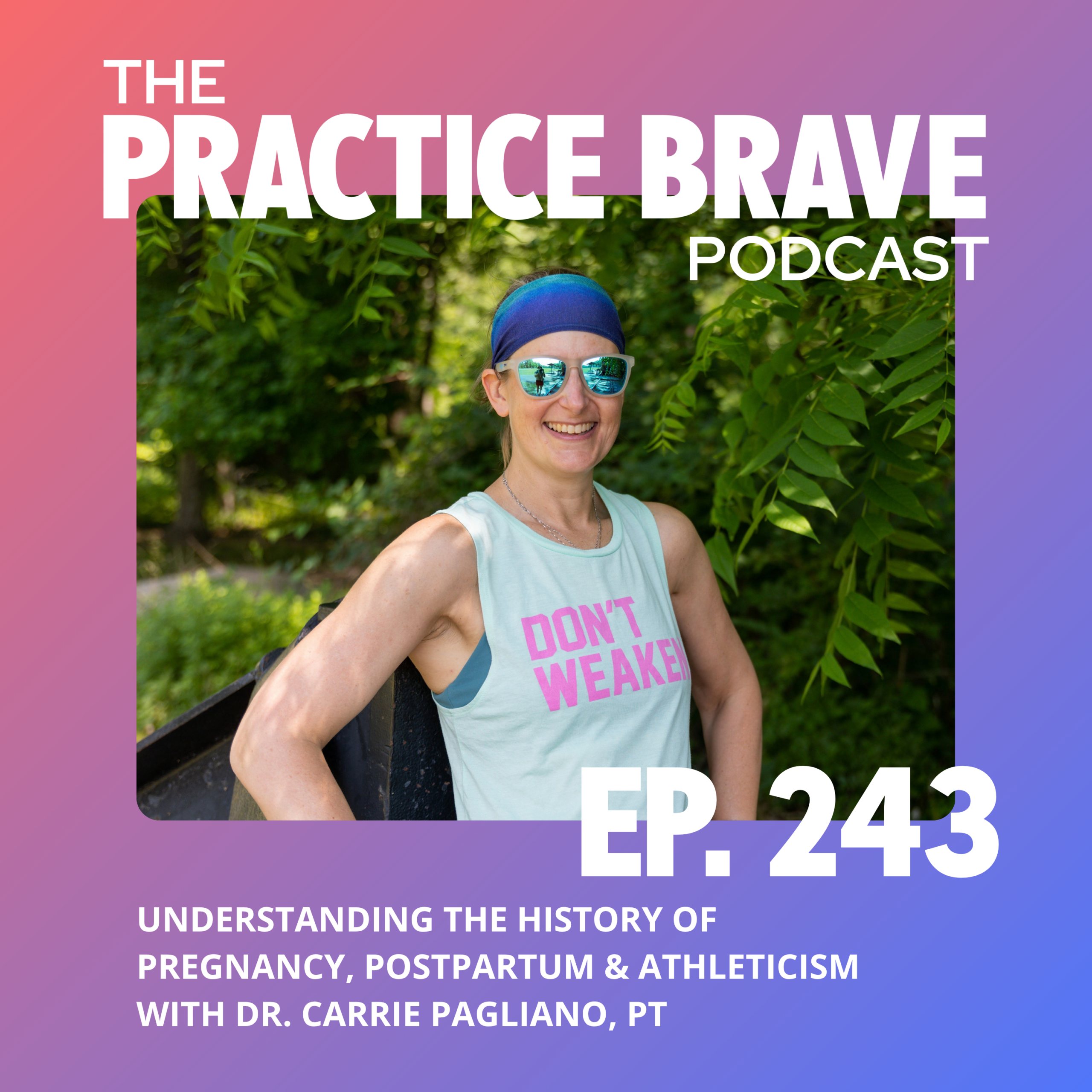
This episode is a little different because Dr. Carrie Pagliano and I are bringing our two podcasts together for one conversation about the history of pregnancy, postpartum, fitness, and women’s athleticism.
We’ve both been working in this space for more than a decade, but we come from different professional worlds; Carrie from the physical therapy and clinical side, and me from the coaching, strength and conditioning, and athlete side. We wanted to look back at where we’ve been, what has changed, and what we’re still seeing repeat itself today.
We talk about how dramatically the fitness landscape has changed for women, the evolution of pregnancy and postpartum exercise messaging, and the tension between the medical and fitness worlds. We also reflect on the early days of social media, the pressure to have a “fit pregnancy” and quickly “bounce back” postpartum, and how some of those narratives have continued to show up in different forms.
We also talk about research, collaboration across professions, individual differences, identity, and what it means to support women as athletes across the lifespan. Ultimately, this conversation is about continuing to challenge rigid thinking, learning from what we’ve experienced, and joining forces to keep moving the conversation forward.
Connect with Carrie Pagliano:
- IG: https://www.instagram.com/carriepagliano/
- Website: https://carriepagliano.com/
- Podcast: https://carriepagliano.com/active-mom-podcast/
Want to Become a More Confident Pregnancy & Postpartum Coach?
If this conversation has you thinking about how you can better support pregnant and postpartum athletes, join me for my upcoming training where I’ll dive deeper into practical, evidence-based coaching strategies.
👉 Learn more and register here: https://coach.briannabattles.com/webinar-registration-page
EXPAND FOR EPISODE TRANSCRIPT
AUTO-GENERATED TRANSCRIPT
Brianna Battles 00:01
Welcome to the Practice Brave podcast. I am the host, Brianna Battles, founder of Pregnancy and Postpartum Athleticism, and CEO of Everyday Battles. I’m a career strength and conditioning coach, entrepreneur, mom of two wild little boys, and a lifelong athlete. I believe that athleticism does not end when motherhood begins, and this podcast is dedicated to coaching you by providing meaningful conversations, insights, and interview topics related to fitness, mindset, parenting, and of course, all the nuances of pregnancy and postpartum. From expert interviews to engaging conversations and reflections, this podcast is your trustworthy, relatable resource for learning how to practice brave through every season in your life.
Carrie Pagliano 00:51
All right, we got a duo here. We got the Active Mom podcast and the Practice Brave podcast, and we’re doing a mashup, looking at what the hell we’ve been doing the last 1015, 20 years in history, Brie reached out and she’s like, “Let’s chat about history. And I said, “Okay, yeah. So here we are.
Brianna Battles 01:08
Yeah, absolutely. I feel like I said something on my Instagram story the other week where I was like, “I feel like I’m becoming a historian, where you have to understand where we’ve come from to understand how history tends to repeat itself, and what we’re seeing culturally with a lot of our pregnant and postpartum athletes, and just what’s being showcased, the conversation that’s having, and how to keep a lot of perspective because we have seen it, we were there for it, and we’re back.
Carrie Pagliano 01:36
Yeah. No, and that, and and I think I went back and told you. I said, you know what? That’s one of the things when I I’m asked to teach at universities. I have been trying to teach them the history, and they don’t like it. They’re like, “Oh, well, teach me what to do. I’m like, “You need to understand the history to know where these things came from because they’re going to come back around again. And depending on where you practice in the world, you’ve got to recognize: is this up to date? Is this not up to date. Why did we kick this to the curb? But yeah, then I feel like an old lady.
Brianna Battles 02:07
I know, I know. My son would say, you know, an unk. It’s fine. I don’t know if we knew that slang, that slang yet.
Carrie Pagliano 02:14
I don’t. So let’s set the scene here because I I think that’s important too. My oldest is now with his driver’s permit, so he is 15 and change. Then comes Cade, right? Because Cade just turned 13. That’s
Brianna Battles 02:31
turned 13. Yep.
Carrie Pagliano 02:32
My daughter turns 13 tomorrow, and then Chance is how old now?
Brianna Battles 02:39
Just turned nine.
Carrie Pagliano 02:41
Oh my gosh! So you’re almost at double digits.
Brianna Battles 02:43
I know for
Carrie Pagliano 02:43
both of them. The baby, the
Brianna Battles 02:45
baby is almost 10. Well, we’ve got another year, but still, yeah, it’s wild. Like it’s wild because I started coaching this population when I became that population. You know, like 13 years ago, and I think we come from two totally different worlds, even though they’re extremely complementary. You, being in the practitioner world, come from, I would say, a much more conservative approach to all conversations around pelvic health and and fitness, especially like back then. And then you know, like they weren’t as like fitness forward or sports forward as it is today. I think as a profession, and then the coaching and fitness world, and especially athlete world, has kind of been ahead of that curve for a long time. You know, like they’re training really hard. Like I think CrossFit, 1520 years ago, did a hell of a lot of good things for women, empowering them to lift and like just that culture for women. And so, if you’re coming from the athlete or coach side, it’s a very different conversation than coming from the practitioner, medical, or even the research
Carrie Pagliano 03:46
side. I’m I’m even gonna pull one earlier. Like I’m gonna call my Gen X card out here. If we go back and think, like I I graduated high school early 1990s, so 1994. I was super lucky to have an amazing coach that was thinking ahead on a lot of things. We were doing cross training for running. We were doing plyometrics. We were doing visualization. All this stuff. So I’ve been really fortunate in that respect. But if you think back to what the culture was, it was exercise videos. Women, if they did go to a gym, maybe it was gold. But you didn’t go back in the corner because there was the the big beefy Schwarzenegger guy with like the skinny tank top deal, and I very much remember in when I left for college, my mom going to the gym at the school that she taught at, and she would swim and do a little workout before, and that was like unheard of
Brianna Battles 04:36
right
Carrie Pagliano 04:36
then, and it wasn’t it wasn’t like societally acceptable for like not everybody was a runner. Not everybody went to the gym. Or if you did, it was like classes or things like that. So like that that was kind of as a PT. Like I think we had. I know we had one Therapex class where we went to a Nautilus gym. Do you remember Nautilus?
Brianna Battles 04:57
Yes.
Carrie Pagliano 04:58
Okay.
Brianna Battles 04:59
But I remember. Through like the fitness equipment, not like yeah,
Carrie Pagliano 05:03
yeah, yeah. No, and I I worked there for a little bit, and like that was like the gym component that we had, and that was our reference point. So so really strength and conditioning, we would was very separate. Yeah, we had a couple PTs in my class that maybe got their ATC to become a trainer and learn a little strength and conditioning, but like that was that was your realm. We were in our realm
Brianna Battles 05:29
totally. Like none of the two
Carrie Pagliano 05:31
should meet.
Brianna Battles 05:32
Yeah, absolutely. And I think you are you 50? Are you 10 years? Yeah. So like I think that millennial generation kind of came in where it was becoming more normalized. Even then, like I was still oftentimes the only girl in the lifting area. I started lifting in high school, and then even like early college because I was playing sports in college and getting my degrees in exercise science. It was more normalized there. But then when I would like go home for summer, like I’d still be the only girl with a barbell when I would be like lifting it, you know, like LA Fitness or whatever it was, you know. So it’s like the millennial women were kind of born into that becoming more socially acceptable, yeah, and more encouraged and more empowered. And I only saw that grow through like the later, like the 2010s, is when it like I really feel like it exploded for us. Do
Carrie Pagliano 06:19
you think that was because of the sport that you did. Was that because of water polo? You think, or California, or just all the things?
Brianna Battles 06:29
Yeah, I mean, I graduated college in 2008, and all of the teams were lifting back then. Okay, it wasn’t just water polo. So when I when I think back to like strength and conditioning, there was a lot of thought of teams and and women lifting that was more normalized.
Carrie Pagliano 06:45
Yeah,
Brianna Battles 06:46
I would say that from a strength conditioning perspective, when I went to my first NSCA conference in in 2008,
Carrie Pagliano 06:54
yeah,
Brianna Battles 06:54
I was one of the few women in the room, and I was like a baby. I was 22 years old, and I went because I was like, I just I need to get my CSCS. Like I need to pass this while exercise biz is still close to my brain. Yeah,
Carrie Pagliano 07:05
it’s still in your head.
Brianna Battles 07:06
It’s still there. Still there. I better. I need to take this test. And I just remember looking around the room, being like, “Wait, where are the other girls? Where are you at? You know. And there were so there certainly like women that have come before me, like I will always say that there just was not the abundance. I’d say that we’re seeing now is women in coaching and women in strength conditioning, women in collegiate athletics. There just was not that was not as much of the culture in those like early 20s. If
Carrie Pagliano 07:34
you, I don’t know if you’ve ever read the book Daniel Friedman wrote. Let’s get physical. She kind of talks about the history of all of that kind of coming out from, you know, who was the guy in the jumper? You know who I’m talking about, old dude Jack Lalang or something like that. You know, from that all the way up through, and then Maggie Mertens wrote a book on kind of women and running and all of that. And there’s so many things like societally it kind of comes through. But you’re you’re right, right about that time that you’re coming out, we’ve got the start of CrossFit, yeah. And then I very distinctly remember my field, and it’s so funny now because everybody and their brother. My office is next to a CrossFit gym, and I have a friend that works inside of it, and they’ve had a PT in there for years. Like it’s so normal now to have PTs, and back then it was like CrossFit’s gonna screw you up. Like, yeah, it’s
Brianna Battles 08:24
dangerous.
Carrie Pagliano 08:25
Oh, they went after Kipping.
Brianna Battles 08:27
Oh, I know.
Carrie Pagliano 08:28
Like, you’re gonna hurt yourself. That’s uncontrolled motion. Like, it wasn’t like it had nothing to do with even like women. It was just like, what is this? And they very distinctly remember. Oh my gosh! You saw the video too, and this is probably around the time that you’re you and I were both having kids. The video of whoever that guy was-he interviewed an OB/GYN or interviewed a woman on a CrossFit YouTube video that said it’s okay to pee when you lift because my OB/GYN is here, and she said that it’s fine too, and so that’s I think when we started to be a part of that conversation, and
Brianna Battles 09:07
our yeah
Carrie Pagliano 09:07
stance was no, that’s bad, and then we didn’t have any way to fix it, which I’m like no, this is wrong. So we like to be we like to be the police. We very like, but I think that’s how I was taught. Was like,
Brianna Battles 09:21
right?
Carrie Pagliano 09:22
You are a gatekeeper to movement, whereas you’re like, I am movement.
Brianna Battles 09:26
Yes, and it’s been interesting in this world because we both work with the same people, but we’re coming from two different places, and or like, and or even like who we are typically seeing. Because I think it still took a long time for an athletic woman to go see a pelvic floor PT. That was not normalized until I don’t know seven, eight years ago. Like where you started seeing an influx of that a little bit more. You know, I sort of like track this by like where I was at in my like becoming a pregnant athlete, then postpartum. Like I remember. When I was postpartum with Cade in 2014-ish, like the PT I went to told me to push my abs together, like literally just like oh my yeah and push my abs together and like so. But as a coach, I was like, okay, great. I found someone who says that they work with someone who has a diastasis, and then when I went to her, I was like, that doesn’t remotely make sense from like basic exercise physiology. Like, what did I tell you? What?
Carrie Pagliano 10:26
See, you didn’t even get the Theraband. The key was this was the key was you took the Theraband and wrapped it around and pulled it taut. So the idea was if you train the muscles where they were supposed to be, this is how freaking ridiculous this is. If you train them where they were supposed to be closer together, then they would learn. It’s like what? Yeah, but like back back up a hot second. Like when you found out you were pregnant with Cade, like what was your activity level at that point? Because I feel like you did like triathlons and all sorts of stuff too. Like you were you you were pretty active. Yeah, I
Brianna Battles 10:58
did. I’m done it out, girl. Yeah, yeah. No, I mean, I went from Division One water polo, and where you’re training like three plus hours a day. I was working in corporate wellness. I was coaching Division One water polo, and so I was already living like that high drive lifestyle. So, like, why not add in like a lot of running? Why not? Because I had to replace. It was like replacement therapy. It was like if I’m not training three hours a day for water pool. I’m going to get fat, so therefore I have to like run or do triathlon or something for two to three hours a day, and so then I replaced it with that while doing all these other things. And I was like, again, pretty pretty young, and that was like got married two years later, and so we both got really into triathlons, did a couple like half Ironmans, and did that world for a while, and then got into CrossFit, like probably in 2010, 2010 probably started CrossFit, and I’ve I’ve always done CrossFit a little differently than I think a lot of people, and that’s why I’m forever like attached to CrossFit, even though I’m like I’ve never truly like formally been a member or like been part of a CrossFit gym as like going to the 9o’clock class. I I never ever in the history of my involvement in CrossFit was ever like truly a CrossFitter, but I was always adjacent. I would like train there because that was an environment where I could drop barbells and do a lot of my Olympic lifting that I did in college, and I couldn’t do that at Gold’s Gym, so that’s why I started training at a CrossFit gym, I had friends there, and I knew the coaches, and so it was. I could just go in there and train, and then I was just part of the community without being immersed in the community. And that is, I feel like that’s just how how I do everything. Is not a total conformist on anything. So I did. I was doing CrossFit. Yeah, been a nonconformist from the beginning. I was
Carrie Pagliano 12:42
gonna say, and I think that’s why we get along. Yeah, neither of us drink Kool Aid very well. Yeah,
Brianna Battles 12:47
so I trained pretty hard through my pregnancy because back then in 20, this was 2013, we saw this huge rebellion against that fragility messaging, especially within the CrossFit community, because these were women who found the barbell, were feeling empowered, were getting freaking strong, and they were showing that off on social media. Social media started around that time, 2012, 2013. Instagram started started going, and we saw a lot of people sharing about their fit pregnancy and what it looked like, and basically be a badass because it is safe, it is beneficial, and the harder you train during pregnancy, the easier your birth is going to be, and then you’re going to be able to bounce back, and your baby’s going to come out with a six pack. That was the narrative, and holy shit, is that not still so much of a narrative that we are seeing all of these years later in a lot of ways?
Carrie Pagliano 13:34
Well, and I think that’s really interesting because you said all that stuff was out there, but I feel like people were getting a lot of shit back then, or at least we were probably throwing some. A lot. There was definitely
Brianna Battles 13:44
shade thrown, but that fuels any ego of an athlete. They’re like, “Tell me, I can’t watch this. You know what I mean? They want that confirmation bias of like, “I had this fit pregnancy, and now look at what I’m doing. So it’s like the athlete community did not care about the shade being thrown because shade was thrown towards that CrossFit group anyway. They were intense, or they shouldn’t be doing this, or they shouldn’t be doing that. So it was like, for our pregnant athletes, it was like it was even more of almost a this responsibility to prove that you were not fragile and like look what you can do. And so, throughout my whole pregnancy, I documented what I could do. I had certain metrics that I wanted to maintain in terms of like my lifting load, my running, my jumping, all of that. How heavy I was lifting-that was really important to me to maintain because I was convinced that if I didn’t keep lifting the same loads, then I would be so weak and at such a disadvantage coming back. Yeah, and so that was that was a narrative. Zero talk of core and pelvic health. I think in anything online, really, at least not that I had that. It did not come across my world whatsoever.
Carrie Pagliano 14:53
Yeah, I mean, and that’s where again that that kind of parallels a lot of what we were. Sort of navigating, so I started doing pelvic health in 2001, separate from orthopedics and sports, and they were two completely different silos. Yes, and to be honest, I hated doing pelvic health. It was boring to me because it was either if you were pregnant postpartum, it was Kegels. Maybe I gave you an SI belt if you were pregnant. Postpartum Kegels for leakage or polyps. We did biofeedback. Maybe we did some internal work for pain with sex, and then there was pelvic pain, which was this whole other beast that I actually dove into for a long time because it was complex and and actually a lot of the things that I learned about the capacity of people navigating pelvic pain came around and helped shift my perspective on we’ll talk in a bit like navigating these higher tone issues or whatever it is that we’re we’re calling this and I think any sort of sport because there was this idea that if you had a tight pelvic floor, exercise made it tighter and made it worse, which we know that that is not true. But when to to kind of circle back to what you were talking about, like for us when we we didn’t have people come for preconception visits, we didn’t have.
Brianna Battles 16:22
Like that was so taboo. The fact that you even got into pelvic health as a like young.
Carrie Pagliano 16:28
Oh, it’s bizarre. Young
Brianna Battles 16:29
like young professional like that was so taboo and so weird. Whereas like now it’s like trendy. You know, like it’s now it’s like empowering and like
Carrie Pagliano 16:38
I didn’t want to tell people.
Brianna Battles 16:40
Right.
Carrie Pagliano 16:41
I hated telling people because inevitably I was in my 20s, and so you tell somebody, and then they sexualize it, and then you know it’s just it’s not a cool like it’s cool if you do sports, it’s cool if you do this you know neuro or things like that. So I really kind of was like, okay, whatever. And but I think you know the way the logistics were set, we really didn’t see people in pregnancy unless it was like for an SI issue or something like that. And then we needed a separate referral. I remember this. This is back when we needed physicians’ orders to start physical therapy to all 50 states. You don’t need it anymore.
Brianna Battles 17:15
Which also was not that long ago. No,
Carrie Pagliano 17:18
again, I’m just like, oh my god, I’m so freaking old, but I’m not. No, but like because it was a change in status, and this was working in a health system. Because it was a change in status, I could not start somebody before six weeks.
Brianna Battles 17:32
Yeah,
Carrie Pagliano 17:32
because I needed that stupid clearance, and that’s and that’s where I think a lot of the six week kind of narrative got its power was, and and and we can have a whole separate podcast about AMA and how they own the codes that we charge, and yeah, whole other conversation. But yeah, a little bit, a little bit. But I mean, then it was like, okay, well, if we start at six weeks, this you can only do this, and we. It was a lot of, and I think it was well intentioned, and I mean that in the kindest way because we didn’t know it was okay. We don’t want to make these things worse, and because we’re from coming from a perspective of something is wrong, that was the lens that we saw. So I was going to see somebody with pelvic floor issues or diastasis, and so then do you start making the assumption that everybody navigates this, right? And that really was our sort of view. And then you see these side conversations of, okay, don’t it’s okay to pee when when you jump or lift or things like that, and we’re like, okay, that’s not good. But we also didn’t have a solution for the healthy,
Brianna Battles 18:47
right? Like how to translate it to what they’re doing anyway, because it was so like in this silo of pelvic health and yeah, internal exam and primarily like older people or like you said, someone who’s already navigating this injury or these symptoms, not your young 27-year-old, like forever athlete person.
Carrie Pagliano 19:08
Yeah, yeah. And if we did see those, those were usually pelvic pain. And again, that was the one. So I started kind of mashing things up. Gosh, when did I? I went to Georgetown in oh four maybe five started mashing things up probably mid 2000s and then realizing my God why are we dividing these things and right around that time too ironically I’m navigating my own hip FAI issue and realizing gosh there’s some crossover with hip and back, and like all of these things are mashed up. Who knew? It’s not. It sounds so dumb now.
Brianna Battles 19:48
I know, but it’s not dumb. It’s not dumb because, frankly, there’s still so many people, and we have these camps, right, where it’s like we are in our own echo chamber on social media. But this conversation is still like. Eye-opening for so many others too,
Carrie Pagliano 20:02
and I I think that’s because there’s going to be people listening to this from all over the world, and I think it’s really important to understand that depending on who you hear things from and who you surround yourself with, you may have narratives from the early 2000s, you may have narratives from 2026. Like, and and I think that’s the purpose of these conversations is like, and that’s where the history does matter,
Brianna Battles 20:27
yeah,
Carrie Pagliano 20:27
because we don’t want to repeat the things that didn’t go well. But at the same time, it’s important to understand where some of these ideas can’t, yeah, how it’s
Brianna Battles 20:35
evolved and how like,
Carrie Pagliano 20:37
yeah,
Brianna Battles 20:37
if you cannot, and it’s this is so hard because we all want this, but there’s just like this confirmation bias where you’re like, “Well, I saw this, or I was told that, or I read this headline, and they’re gonna take it at just that and not a deeper level. And there’s too much attached to pregnancy and postpartum and performance and pelvic health to go off of one sentence that somebody told you at any point in time, or one headline that you read, or whatever. Like this is not a straightforward conversation as much as we would love to simplify it. As yeah,
Carrie Pagliano 21:10
well, and and I think talking about other parallel conversations that were happening in our field at the same time. So, like, let’s just talk. You know, hip FII labor terrors. Basically, they started being able to do arthroscopic surgery, so now everybody and their brothers interested in it, right? And let it be known that I had my surgery before A Rod and Lady Gaga, so they followed me. No, but it was the conventional wisdom at that point to still do like a lot of stretching and really gentle stuff. And I mean, this was before kids. I had to do 45 minutes of rehab in order to do a pain-free run, and I was like, “I’m not going to do that. And that was before I had kids, and and so that shifted, and and for me, it shifted as well. It wasn’t until I started heavy lifting that that felt better. But if you go back and look, even at what we know, and if you go back and look in the running literature, same freaking thing. 20 somethings we didn’t we didn’t lift and run right, and there was starting to be a shift there about hey, we need to do these things. Does it impact, you know, your longevity, your performance? Does it change anything with injury? Like so, there’s these parallel conversations that are happening all up through, and I think we were like this weird offshoot because there’s all these kind of right
Brianna Battles 22:27
because that was like more like sports med and more ortho, and that was like so it was kind of progressive in those conversations, but pelvic health was still not being included as part of no anything ortho related, anything sports related, or that they even had a connection whatsoever. No,
Carrie Pagliano 22:44
and and our mantra at the time, and so dumb now, and I hate it when I hear it now because I’m like, no, can we not do that? Is put the pelvis back in the body, and I’m like, I haven’t even
Brianna Battles 22:55
heard that.
Carrie Pagliano 22:56
Oh, you didn’t hear that one? Oh God, that that must be just like a pelvic centric
Brianna Battles 23:00
one. Yeah, I missed that memo because I’m like, what?
Carrie Pagliano 23:03
No, but like, but that’s how we were trained. We were trained in, and and to some degree, that still happens today. Like, whenever I have a new pelvic par physio, or they want to go into it, they’re like, I’m doing my my affiliation. What’s what’s the best advice you have? I’m like go learn something else from someone else, and then come back and apply it. I don’t care if it’s neuro ortho sports, something because if you have just this, you are missing the boat. You need to have the the context. Yeah, but that was such a like a nuanced thing, and there wasn’t anybody in my area doing it. This was pre burst of social media, so the only people you kind of talked to were conferences or things like that. And I think around that time is probably when when we maybe started to know of each other a little bit. But like I think it was after Cade and my daughter were born.
Brianna Battles 23:59
Yeah, yeah, because I was kind of just on an island. I wasn’t really even sharing from a professional standpoint. Yeah, I was still just like learning, and I was sharing on social media. I was what I refer to now is like the best way I can phrase this is like it was a performative pregnancy and a performative postpartum because you want to show like what look at what I’m still able to do, and then postcard. Look at how fast I was able to do this, or to look like that, or whatever. And it was just like it was so performative. And honestly, I have so much grace and empathy and understanding for that because that is our own coping mechanism. Like I will never judge somebody for like what they’re doing or what they’re not doing or whatever. Like their timelines, I don’t give a shit about that. It is more of like I know the the act when we peel back all of these layers of trying to be achieving an achieving person in all categories of life. So much of that comes down to fear, insecurity, ego, identity shift, change, loss, depression, anxiety. All of these things. Like there are all influences. There, so that’s why I I will always go beyond like let me just like safety or physical ability. I’m like God that is like that is the lowest hanging fruit. But under that is like such a deeper conversation of like what are we trying to hold on to and what are we willing to release and how are you willing to meet yourself on the other side of like who you’re becoming during these seasons. It is not like athleticism does not end when motherhood begins. I’ve been saying that for over a decade,
Brianna Battles 25:24
yeah. And
Brianna Battles 25:24
it’s funny because I think there’s still this fear and this FOMO and this desperation to prove something to yourself or to or to others, and it is performative, but it’s not coming from a place of like I don’t know. It’s just it’s been interesting to observe it present itself very similarly, but just with different influences now.
Carrie Pagliano 25:45
So we’re we’re going to come back to that when we talk about perimenopause at the end because I I use the term I ironically and I don’t think we’ve ever talked about this I use performative perimenopause. Yeah. Um. So we’re definitely see that. Let’s put a pin in that one. We’re going to put a pin in that. We’ll come back around to it. But um, yeah. So when I had my son, like I said, he’s over 15 now. I think I had all intentions of oh, I was going to run through my pregnancy, run into the the delivery room. I had no plan for that, none. And got to about 19 weeks, and then was just super uncomfortable. Had a lot of stimulus pubis issues. Could barely walk. Whole thing. Delivery was interesting. On the other side of that, and I think this is how a lot of people got into pelvic floor is they were taught one thing and blindsided, which I was. I had a three day induction, ended up in in a C section after pushing for a couple hours, I think that’s why a lot of people got into it. I was already in it, right? And then you’re like, ah,
Speaker 1 26:49
yeah.
Carrie Pagliano 26:49
Eventually got out of it. Kind of was like, okay. And then like, okay, we’re gonna do this again. How does this go? But we still didn’t have any sort of plan because the plan I was given, I was taught, was just to do this gentle shit,
Speaker 1 27:01
yeah,
Carrie Pagliano 27:02
and it didn’t work. And I’m lucky I didn’t hurt myself in between the kids.
Brianna Battles 27:08
I know, and it’s so funny because like you were told do gentle stuff, and it didn’t work. I was told go harder, see what you can do. Also, that didn’t work. So it’s like again, that is why we cannot sit on these like fragile or invincible ends of this spectrum.
Speaker 1 27:25
Yeah, you
Brianna Battles 27:25
have to be in that middle ground of like being adaptable with your training because that applies to literally every other sport, every other athlete, all other performance goals. It’s not about training the same way all the time year round to hope that you’re peaking in March or whatever it might. Yeah. No, no, no. You are strategic with what your body and your training volume, intensity, loads, what all of that needs for when you’re trying to peak. Which for most people is the other side of postpartum. That’s like a year postpartum, you know. And I think we’ve like we have totally lost the plot in the attempt to be empowering. We’re also like we’re just missing pieces of the conversation that are going to help women actually reach their long-term athletic goals while still at least being considerate of their pelvic health and the changes that their body is experiencing. Not fragile, not invincible.
Carrie Pagliano 28:14
You you said something earlier I thought was really poignant. Was talking about kind of that identity and ego piece of it that I think needs to be kind of acknowledged more, and I talk about a portal with patients. I was like, “Look, we’re going to have a lot of conversations right now. I’m going to repeat myself a whole bunch of times. We’re going to talk about a lot of possibilities, and you’re going to have a little narrative in your head that says, ‘Oh, well, that one happened to me, or this, or that, or or whatever. And then you’re going to walk through the portal, and then you’re going to hear everything I said in a completely different way. And I said, “There’s no other way than walking through the portal. I’m so sorry. I wish I could just implant my brain, but this is just how it is. And I see 99 point 44% of the time with first time moms that I it’s like a visceral desire to find identity again, and some people feel like they want to find the old one. Some people are fine with like whatever the new one is, and then some people just don’t care. How much of that do you think drives? I think the choices that people make and the everything and the people that they follow and the things that they do. Everything
Brianna Battles 29:29
we we want confirmation bias. We want to be told you can lift as heavy as you want, and that’s going to fit my bias. You can lift and compete, and you can run, and you can do all these things as much as you want confirmation bias, but it’s not just your ability. Like it’s really, what are we feeding? What do we know? Are we actually informed, or are we performative? And again, it’s not necessarily bad. It’s just it’s an attempt to control. And I’ve done a whole lot of therapy, baby. So like I’m speaking to this as an older sister. I’m speaking. Through this as somebody who’s lived it, and more importantly than my personal experience, I have walked this path with dozens of professional athletes and 1000s of women around the world for a long time now. Like there is nothing you and I have not seen in this conversation, but so much of it comes back to control. I want to control what my body looks like. I want to control what my body can do. I want to control my timeline. I want to control my outcome to the best of my ability, and we are told, especially for athletes, this is which is different than what our Gen Pop is told. So I want to be really clear with that, because I think our Gen Pop is told like we kind of have to encourage them to exercise more. You know, like we are trying to like they’re they’re still a little bit concerned of like I don’t want to hurt the baby. I don’t want to do this. Like we gotta, we they need a little kick in the ass sometimes to do more to be empowered. Whereas our athletes need permission to adapt. They don’t need permission to just full send it. They can, and frankly, they likely will anyway. But they do. It does need to come with being actually informed of their body. And I don’t think most of them are as informed as they need to be, and I think if they were, then they would be making different training choices. Because athletes, when you really talk to them, they understand process, they understand peaking, they understand periodization, they understand progressive overload, they understand needs analysis. When you talk to them, like you would any other freaking athlete with any other sport and performance goal, they’re like, “Oh, I clocked that. I got that.
Carrie Pagliano 31:20
Yeah,
Brianna Battles 31:21
but pregnancy and postpartum, we have still kept in such a silo of trying to be empowering that we are missing the performance piece of all of this. And what matters to our athletes? Long-term athletic performance-that’s the ultimate goal. What are they trying to do during pregnancy? They’re trying to maintain out of fear and control of not being able to get to the other side and accomplish their goals, or keep that identity, or still be a runner, or still go to CrossFit, or still lift, or whatever it’s going to be. So they think that in order to get that on the other side, they got to do as much as they can still during pregnancy. Instead of saying like, actually, this is a different period of my training, and it’s okay for that to look different. I can still lift. I can still run. I can still do all these things, but it doesn’t have to be the same, or it can be at a slightly different capacity, or I don’t have to be pushing boundaries out of fear, FOMO, or the comparison culture, which is blowing up everywhere right now. Because frankly, pregnant and postpartum athletes are trending. I’ve never seen it like this. People are finally getting on board and having this conversation, acknowledging that this is indeed an avatar of a human, and so they’re trending. But with that comes so much control of like, well, look what that woman was able to do at 30 weeks pregnant, or how fast she is, or how much she was lifting, or what she’s doing, and that is the bar we’re comparing to. But what we do not know is what that woman actually knows about her body, beyond the ability, beyond the safety, maternal needle safety. Like they have that box checked, it’s everything else.
Carrie Pagliano 32:51
Well, and I think that’s something that that probably has changed so much, and probably I’d even push it at three to five years, and this is where I think there’s a frustration as a clinician, and and also how I’ve had to change my understanding of research because I think coming up as a young professional research to me meant something new and groundbreaking that would change my practice, and with what I the time that I’ve spent with so many researchers over the years is is I have had to learn that you have to establish that there’s a need for it, and that’s where I think the women who have you know set foot in the gym when nobody would women that worked out when they were pregnant, women that returned to to sport in postpartum, those are the women that we now have documented to say, hey, you know, there’s women doing it. There’s a need to study this. I mean, even just the the couple studies that were done looking at supine weightlifting and even exercising supine, I still have moms come in. I’m sure you do too. Oh, I don’t think I’m supposed to, you know, sleep on my back or exercise. And I’m like, no, we’re good. Like we’re fine now. But we had to have that establishment of this is happening, and it’s enormously frustrating if you if you don’t understand kind of the order of research. You’re like, I want I want it now. It’s like, no, we have to establish there are women doing this, and they’re okay. Now let’s start to look into it, and then let’s start to look into the interventions. And that’s where I, you know, as far as we kind of have two camps in research world right now, we have the general pregnancy postpartum exercise camp. A lot of that is based out of Margie’s lab in in University Alberta. You’ve had a chance to chat with her. She’s a freaking rock star, but just even saying women, it’s okay to exercise in pregnancy. To your point, the general population we have women that we have scared off saying, “Oh, you’re pregnant if you weren’t exercising before. Exercise now. Yes, we do have great data now that says exercise. In pregnancy will reduce your pregnancy-related complications. We don’t have any data to predict what it will do to your postpartum, your delivery, or recovery. We can’t say that, but we do know it will reduce those those complications. And even with the postpartum guidelines that just came out in 2025, the the the minutes, the phase-based approach, saying, okay, let’s let’s let’s get your head above water first, then we start moving and and not put a timeline on that. I think it just opens up so many more options for women, which is like great news. But also, you’re gonna have these outliers. I just saw Rachel Tenia; she was on our podcast a couple years ago. She does Bumped Labs. I don’t know if you you followed her. She just had her fifth, and two days, two three days ago, and she’s out doing a walk run with a double bob and a baby in a car seat in it. And I was like, “Yeah, physically that was like she was a better marathoner before me, and like I’m never going to be at her capacity. I never physically could handle five kids. Clearly, she’s that 1% and I hope people are looking at that appropriately and saying that is okay. They’re not looking at
Brianna Battles 36:08
that appropriately, though. You know what I mean? Like they’re not.
Carrie Pagliano 36:10
But that’s but that’s and and that’s where I think to come back to the ego and identity is like to know your and what you were saying about you need to know yourself.
Brianna Battles 36:18
Yeah, and you need to understand like basic strength, in conditioning principles, because again, we treat pregnancy and postpartum like there’s something to prove, and like that, like that basic like a rehabilitation process is not something that we apply in across a variety of of fields and injuries and
Carrie Pagliano 36:38
yeah,
Brianna Battles 36:38
like like progression to performance. Like progressive overload, is a thing. It just is. Like it works. It’s effective. That’s how everyone becomes great at what they’re doing. And we dismiss that completely in the pregnancy and postpartum exercise conversation, us because a lot of it is coming. Like the research has to set that foundation for sure, and then you can build upon that about like get a little bit more nuanced with it. Right now, it has to just set a foundation and validate what women have been doing or what they’re doing. Kind of like you know, it takes a while for it to reflect the reality of what women are doing. So that foundation is being set, which is so important for our Gen Pop and for our medical community to then keep kind of normalizing what culturally has been done more in our circles for a while now, but and when we see, it’s just hard because again that comparison culture is very strong, and if she’s doing this and this person is that, and look, it’s no one’s responsibility. I’m big believer in autonomy, like you do, you girl. Like I don’t actually, it’s not that deep for me, but I do care about providing solid guidance the same way I would help any of my athletes reach their long-term performance goal in a way that preserves their body in the ways we can control because we can’t control everything. Yeah, we we have dismissed sports med 101 and strength conditioning 101 from conversations, and it’s driving me nuts.
Carrie Pagliano 38:03
It’s you know, and but here’s the thing though that that’s interesting from a physio perspective is that I think we went in preemptively and we’re like, oh, because you’re pregnant, we automatically are going to dial things back with the hopes of, and we actually don’t have that data. And so I have patients that come in now and like, what do I need to do differently? Nothing, yeah, absolutely freaking nothing. You keep and go, and then when you start to feel like you are not like, I’m not gonna preemptively, you know, change their training until we run into a barrier that says so. Yeah, we don’t have those heart rate barriers to worry about. Yeah, that’s
Brianna Battles 38:39
insane because that’s like was overturned, like that got overturned before I was born.
Carrie Pagliano 38:43
Oh, I know that’s people
Brianna Battles 38:44
don’t like. You know what I mean. So that’s one example, and it’s just funny because athletes, again, different than our Gen Pop. They actually do need parameters. They need to understand your body. They need. It’s not just like adjusting what they’re doing. It’s more so adjusting how. And again, this is where coaching comes in very differently to the conversation that we are seeing, especially online with what our athletes are doing, maybe clinically in the research, it is not like a matter of X’s and O’s. It’s more of like how this that strategy behind it, and really them understanding their body. What does their body need? Not just right now, but what is it going to need long term? How are we setting a foundation to build upon?
Carrie Pagliano 39:20
Well, I also think too that like somebody’s you know zone two could be my zone five you know like like I know but let’s let’s be aware that I am not I know but I think you know to your point like to to understand where you you fit in all of that but to to go in and automatically be like okay we have to change this because you now have this different status. Like unless there is something medically going on, we don’t need to do that. Yeah. Um. And but but again, like I I think what it all comes back to too, and this is this is you know professional athletes and and everyday ones, is you can be told all the right stuff. You can have the best guidance. You can have somebody in your corner. There’s that little voice that sits over here and says, “But what if? But what if? Are you going to hurt your baby? Like, and I don’t, I don’t think we have to banish that voice because I think that’s like your first, you know, like
Brianna Battles 40:17
their solid paternal instinct to to like at least acknowledge, and it’s funny because like you’re you talk about the voice of like, like almost like the fear based brain. I do not typically work with those people. I work with the athlete brains that are like, I should be able to do more. I should be able to do this still. Why can’t I do that? I should be able to do more. I
Carrie Pagliano 40:38
think you can have those both. I don’t think it has to be one or the other because I think I think there’s people that’s both.
Brianna Battles 40:43
Yeah, maternal instinct is there for sure, you know. And I actually think that’s worth like if you’re if you’re feeling that, like it’s okay. It’s like literally okay to be like, you know what, this doesn’t feel right, and I don’t I don’t like it. I don’t like the feeling that this is giving me, even if it is maybe like we don’t have research for that. You know what I mean. Like you can still feel afraid of hurting your baby if that’s insecurity. It’s okay to honor that. It doesn’t mean that you have to stop, but it’s okay to acknowledge like that’s a real experience for women.
Carrie Pagliano 41:13
Well, and that’s where you know I’m I’m really torn with this. I’m curious your thoughts. The there’s this whole anti-listen to your body thing going on right now, and and again, all these things are like nuanced conversations. Is like people like, oh well, you know, it. I I feel like again, like athletes in general, and you’re going to have those people that are superhuman and and and can do amazing things and do not feel pain, you know, like that kind of thing, and then you’re going to have people that like they know if somebody’s little like a little tweaker niggle or need to pay attention to this, and then there’s going to be people that are going to over obsess. So we have this spectrum, and I think that like telling people no, don’t that that’s not enough. You need to understand those pieces. I’m like, I think that’s only part of the story. Like I don’t want to teach somebody to not trust their body? It’s it’s learning this this this new language, or you’re learning to translate it, and it’s not the same thing. Just like understanding my 50 year old body is very different than probably the very little I listen to my 20 something year old body. Like it’s just a yeah,
Brianna Battles 42:18
you know. And athletes again, which is different than Gen Pop. I will always stand by this. Like how you talk to them is gonna be different. And your high drive, high achieving person, you tell an athlete to listen to their body. They do. They won’t. They listen to. They know how to override that. Isn’t baked into their nervous system to override. And now maybe during pregnancy and postpartum, it can shift a little bit, a little bit. But for a lot of them, it’s still this like I have to do this because this is what I’ve been doing. This is what I know. This is what I’m used to. I’m gonna keep doing what I’ve always done. I’m gonna, and I like this is a conversation I’ve been having for a long time, and I love people love to have the next hot take to kind of counter it because that gets good engagement. But we are we have lost the plot when you actually coach this population of athlete, which is different because Gen Pop, they do need that encouragement of like, hey, it’s okay if like you’re fearful of this, or you had a miscarriage, or you’re managing prolapse, or you have something like they need that empowerment to get in the gym. That yes, you can lift, yes, you can run. But with athletes, they need to acknowledge like, is this actually right for my body right now? They because they will cross that line. They they will cross the line where it’s like my job is to try to give you the best opportunity of being your best self at a year postpartum. That’s my job. Yeah, and we’re going to reverse engineer that process. And that when you reverse engineer progressive overload, it’s not trying to do the same shit over and over and over. When all of these other variables are affecting your life, you’re gaining weight. Your body is changing hormonally. Things are different. We talk about postpartum, where now you’re adjusting to a new baby and sleep, and there’s nutritional difference. Like there’s so many variables in which we were talking about someone who wasn’t pregnant or wasn’t postpartum. Like, oh, geez, your sleep score sucks, and this and that. You’re not going to perform at your quote optimal level.
Carrie Pagliano 44:00
Yeah,
Brianna Battles 44:00
we’ve just completely lost the plot. So yeah, listen to your body. I think is well-meaning advice, but athletes know how to override that all too well, and they will. So this
Carrie Pagliano 44:09
is this is where my head goes when you start talking about that because I still think of that as like a smaller percentage of the population. I start thinking, and I want to understand what the relationship is with exercise. I want to understand what pops into my head immediately are concerns about energy deficiency. Any, you know, because if you’re going to blow through that, I want to understand: is there any history of disordered eating? Is there any history of bone stress injuries, and then that’s
Brianna Battles 44:42
like literally like so many athletes have this history of like whether it’s formally or not of an eating disorder or of body dysmorphia or of like using exercise as this way to out athlete everything. This is a different conversation. And then the people come into you that have prolapse, and we’re told to never lift again. You know? No,
Carrie Pagliano 45:04
I, I, I think I think they can be both. I think they can be both. Follow me here for a sec. So, like, if I have somebody that I had a client come in, she’s military, and which tells me a lot
Brianna Battles 45:15
already.
Carrie Pagliano 45:16
Oh, it tells me too. I mean, I live in D.C. Like
Brianna Battles 45:19
avatar.
Carrie Pagliano 45:20
Well, but but here’s the thing, and this is why I do think that maybe the the definition of of athlete for you does come into a lot of my gym population. I mean, Arlington, Virginia, we’re like the most active city in the country, 17 bajillion years in running. Everybody’s active, everybody’s type A around here. That’s my favorite question to ask: is like, where are you from? And like, if you’re East Coast versus like Podunk, middle of nowhere, you’re gonna have a different focus on things. You’re gonna have a different drive, and there’s reasons that that people stay here. I’ve lived here, you know, 25 years, and so I I think understanding the whole picture is part of it. And so what we talked about was past history, any stress fractures, disordered eating, things like that. Why that’s important to me now is we were able to have the conversation ahead of time in pregnancy that I have. She’s now already set up with somebody in psych to talk about body image. She was able to kind of identify that stuff. We have somebody in nutrition because we know bone mineral density drops in lactation. We’re able to do that stuff ahead of time, and I said, and we were talking about relative risk and things like that. We have some tools now that we can start to screen these things out. I could name at least five other patients in the last, you know, three to five months that are probably what what you would consider Gen Pop, but for me, because how they approach their lifestyle, their lifestyle, their hobby, their sport, those are concerns that I have. But but to the point of, I was not having those conversations a year and a half ago.
Brianna Battles 47:00
Yeah,
Carrie Pagliano 47:00
and I’ve been doing this a long time. Yeah, no, I think it’s so
Brianna Battles 47:04
like just more information on Red S and just the fact that like again, your generation and my generation have all grown up in like the skinny era, like skinny influences, and that has certainly affected the athlete community. Like we,
Carrie Pagliano 47:20
yeah,
Brianna Battles 47:20
like it is, it is so rare for me to talk to literally any female athlete between 30 and 50, ish, even even younger, who how they have not been affected by something with their body and expectation with their body and even their sport. You know that plays into it, and so I always see people, you know, when they come to me as a pregnant athlete, and I do want to clarify my definition of an athlete who I talk about. I’m not just talking about my pro athletes that I work with. For me, an athlete is anyone who’s consistently pursuing fitness across a spectrum of interest and ability. But it’s the fact that they are consistently pursuing it, like they’re living an active lifestyle, even if they’re just going to f45 three or four days a week. That is something they’re consistently doing. That is active and, frankly, athletic because the way women are training now, because we’ve seen this cultural shift, it’s inherently more athletic.
Carrie Pagliano 48:09
Yeah.
Brianna Battles 48:09
So that’s my definition of that. Not just my pro athletes, but you know, I think we’re just-I don’t know-we’re just seeing such a big, a big shift in this. Really big shift.
Carrie Pagliano 48:19
It’s it’s funny you talk about skinny, and I’m I’m gonna to jump over to to perimenopause now because with GLP ones, with the body composition changes that happen going into perimenopause, with all the like, I feel like the the the doors have been broken down on being okay to talk about perimenopause and menopause since kind of the debunking of the the 2002 WHI, when basically they were relating, they were basically like, if you’re taking estrogen for menopause hormone therapy, it’s increasing your breast cancer risk. That was misinterpreted, and also with the FDA in the last year taking the black box warnings off of systemic and local topical vaginal estrogen, everybody their brothers talking about it. People in their 30s they all think they have perimenopause, and I’m like, Joseph, maybe you don’t. But I I think it’s it’s great that everybody’s talking about it, but at the same time, too, it’s the same freaking thing all over again because it’s the wild west. You got people selling literally everything from weighted vests to supplements to GLPs, and we have this expectation of looking like Demi Moore, who really did not look well there for a while. Just those sorts of things, and it feels like like the late 2000s, early 2000s again. I mean, for you because you’re not there yet. What does it look like from the outside? And then I will tell you what it looks like from the inside. I mean, to me,
Brianna Battles 49:57
it very much looks like. A very similar reflection to the pregnancy postpartum space, where it became a thing, and then everybody is wanting to become an expert in it and talk about it and share their personal experience instead of their credible experience, and and you know having credibility there. And I’ll be super transparent here. I’m asked all the time, when do you guys start talking about perimenopause and menopause? And I want to say on record that is not my intention in my business as a coach at least anytime soon because one I don’t have that expertise yet and two I’m not living that yet and to me anything I do and do well I also have to have experienced that’s really important to me like that helps me communicate, helps me relate, helps me understand, and to me, that’s a big non-negotiable. Is like until I have lived it and I have practiced
Carrie Pagliano 50:50
it, I’m
Brianna Battles 50:51
sure as shit, not selling it. Like I’m not, you know what I mean. Like becoming a mom was not enough to be a credible person in this space. I had to learn for a long time, and I had to work with a lot of people consistently for a long time, so I do see a lot of parallels here in the voices contributing to the conversation around perimenopause and menopause in this space, and I think it gets confusing because people who seemingly look like they have the expertise aren’t always like giving the information. Like it’s just it’s like loaded. I think maybe there’s some good stuff, but then there’s a lot of stuff that you’re like, oh, that’s gross. But then there’s others who maybe know a lot, but you know it seems there’s also a lot of mean girl culture there. It is gross to me. The online landscape is very gross, and how people are communicating over all things perimenopause. It’s either feels like there’s gaslighting, or it feels like this is my one solution, and it’s going to solve everything. If you just buy this supplement, or you just do this, or do that, so like both sides, it just feels like a very confusing space. And my mom was somebody who was who didn’t do HRT because she was of that generation where she was told like that will cause cancer, and so she didn’t. When I talked to her about it, she’s like, “No, I I was like fine. I don’t know. I don’t remember that much. I just remember like having some hot flashes in the kitchen, and I I can literally remember being like a teenager. She’d be taking her shirt off and like laying on the counter, you know. So it’s like I think we’ve seen such an influx of women who could have benefited from it, who are now like WTF? I want information. Where do I get information from? What do I do? Do I need it if I’m over 60 now? Is it beneficial? Is it not? I think there’s a lot of confusion, and I think that there’s just it feels like a very messy landscape where there’s no straightforward answers, which sounds a whole hell of a lot like the pregnancy and postpartum space.
Carrie Pagliano 52:41
Yeah, yeah. I mean, in in some ways, it’s like good and bad because yay, we’re talking about it, and I literally cannot go to a sideline. I mean, I I went out for a run the other day, and I ran into a swim mom that I haven’t seen in a couple years, and and we were chatting about stuff, and sure enough, we ended up talking about it. It’s that I mean, like that’s just that’s just where I am right now. Yeah. Um, and I think to your point, everybody is just feeling bombarded because, and this is probably what’s different than early pregnancy, postpartum back then, but probably not now. Yes, is that we were not bombarded because we weren’t on social media all the time. This wasn’t a thing, and I think you know we have to start with a caveat of most people are selling something, and that’s fine. But if they’re selling something based on I did it and you can too, and you know I think that’s the part that sometimes people don’t see. Yeah,
Brianna Battles 53:39
and being like a smart consumer, where you’re like, if it sounds too good to be true, it probably is. Because there was like one size fits all, or this hack, this supplement, this injection, this thing that you could just solve all your problems. And like, it’s not saying that some of those things might not be helpful. They might be helpful, but if it was as simple as this one thing that this one person sells, like that’s not being like we’re losing the plot there too.
Carrie Pagliano 54:01
Again, it goes back to the pain points, and I I think you know perimenopause hits on some of the the really basic ones when body image too. Moms feel burnt the f out, like we are exhausted. There’s so many more demands. I mean, parenting in this day and age feels light years different from you know when when we were kids. Yeah, I’m sure every generation says that. By the way, I don’t think we’re unique in that. Yeah, and I think there’s just more expectations and and you know adding, you know the social media and FOMO. It’s just a whole other thing that
Brianna Battles 54:38
like and it’s like the anti aging. So there’s like this, you know, like because our faces are so public and we’re sharing. We’re when we are of the generation where women were empowered to use their voice and to be forward facing in their career and all these other things. Nevertheless, adding social media to that, like there’s I think so much grief, and you’re like, God. Am I still like relevant? And am I aging? I’m aging publicly, and then you don’t feel like yourself. And like, there’s all of these elements.
Carrie Pagliano 55:07
You see the great. I mean, you know what’s so funny? I posted some old podcast episodes recently, and I’m like, oh, I didn’t have to wear glasses then. I could see the screen. Like, oh shit. No, but it’s just it’s it’s I I’m torn because on the bright side we have community, and I think there’s so much to be said for that. But I think also I get incredibly frustrated. I just wrote something recently. My my neighbor I saw the other day, and she had a weighted vest on, and then I always see women, and this is where I was talking about performative perimenopause. Like that’s like your badge around here in Arlington, Virginia, that says you’re peri or you want to be. And I really want to stop people and really try and understand why. And so I asked her. I said, “Hey, I saw you with the vest. Just want to know a little bit more about it. And I mean, she didn’t know where I was coming from, and she’s like, oh my, my, I have osteoporosis. My doctor told me to, and I was like, actually, we there there was a recent study that looked at women with osteoporosis. Most of them don’t. She’s postmenopausal. This one that this is where a lot of the data is again too. We have an area where we do have some decent data on menopause, but not Perry. She is in postmenopausal, yeah. And vest versus no vest really wasn’t the same. And so I was like, “Hey, are you doing something else? And she’s like, “Yeah, I’m on the meds. Like, great, beautiful. Yeah, like we do have data on that, and so on. And so it just makes me mad because we tell people things are going to work, or we tell people just again, it’s just the pregnancy thing. We just we’re going to see postpartum. We just want to do the right. You can
Brianna Battles 56:45
simply peel back some layers and say, “Are you lifting even a little bit? Are you conditioning even a little bit? Like the basics of strength conditioning. It’s almost like those will follow us through our lifetime. But I know that like different generations and what they have been fed, and what is on their social media, what they’re being consumed by, is very different than like where you’re sitting, which is very different from where I’m sitting.
Carrie Pagliano 57:08
We’re kind of problem solving here a little bit. I very much, I think, as a young PT, was like you should da da da da, and now I’m very much like, okay, tell me where you are right now. What is the next easiest thing? Low-hanging fruit. How little do you need to do so nobody dies? Situation that’s going to be in the like the next right thing, and you know, and and this is the part that is really important. You’re going to get out of it what you expect because if you’re going to go to the trouble, put some effort in. You better get something out of it, and that’s the part that makes me mad. Yeah, but it’s because we’re sold a quick
Brianna Battles 57:47
fix in so many different areas of life as a woman. Yeah, and that’s just one of the many things. I always joke because I’m like, I’ve been hiking with Elite. That’s for 15 years. You know, oh,
Carrie Pagliano 57:56
I have like three of them, like
Brianna Battles 57:58
like the like the tactical I mean one, you know. Yeah, and it’s so funny. I was like, I was doing this before people on the internet argued about it, you know. But it’s like, okay, maybe that’s some. If you like walking around your weighted beds, great. But like, go for it. But also, like, it’s not going to replace lifting. It’s not going to solve tuberosis when your nutrition is this, or maybe you’re on a GLP and you’re not also lifting. Like, there’s just elements of this like we are totally missing the forest through the trees, no matter how we spin this conversation. Menopause, aging, perimenopause, pregnancy, postpartum, like the fundamentals will follow us through our life.
Carrie Pagliano 58:35
Yeah, and I think you know we talk about how the nuance is missing from you know social media communication and things like that, and you know, if you don’t have the patience for it, I think what’s important is to look for general trends. One is to be like, “Hey, I don’t have to start with maximum whatever. It’s like everything that we’re asking people to do comes down to consistency. So, like, if you can do it once and then you keep doing it, then whatever that next thing is, can you be consistent with that? Everything we’re ever going to ask you to do that’s going to show a change or improvement requires consistency. Yeah, and you can’t be consistent doing all the things all the time because let’s just be honest: our kids and our families and the world is basically trying to throw grenades into our lives every day, as we were talking about before we got on. Just
Brianna Battles 59:24
like sustainable habit dosing, yeah, that’s not always intuitive, especially for women who did not grow up in this culture. Like I think what you know, the women who are in perimenopause and menopause right now, what they’re experiencing is going to be very different than like what I experience, which would be very different from the generation like right below me, like it’s gonna keep getting better, but the fundamentals will still remain the same.
Carrie Pagliano 59:49
Yeah,
Brianna Battles 59:50
we just might find ways to optimize it. Like we’re like HRT. It’s like, well, what what is that going to look like? You know, we’re we’re learning more. We got the the fundamentals. Well, how do we now sort of. Optimize it or improve. Like I’m lifting, I’m eating well, I’m doing these things. Like my lifestyle’s in check, but what can I add to improve it? And like that can be HRT. Maybe that is a supplement. Maybe it is a form of a peptide or GLP, and we don’t know all of that just yet. Yeah, maybe some things we do know, but it is just a really interesting conversation. Like,
Speaker 1 1:00:22
yeah, again,
Brianna Battles 1:00:22
in an effort to empower people, it it just gets some things get lost in translation.
Carrie Pagliano 1:00:30
Well, I I think it’s also important to when you hear all the noise and that’s not been your experience. So I I have a couple of friends, couple clients, they hear amazing things about you know HRT, and it that wasn’t their experience. And I think that’s valid too.
Brianna Battles 1:00:49
Yeah,
Carrie Pagliano 1:00:49
I think the other thing that’s valid, and this has been my experience, is I was really lucky to quickly have resolution of symptoms, and that lasted for a period of time, and then it needed some adjustment again. And I’m very fortunate to have a provider certified by the Menopause Society. Also, happens to be a local mom. We’ve known each other. Our kids used to play seat all together. That sort of thing. She’s a straight shooter. Yeah. Able to navigate these things with me, and I also have access to her and health insurance. You know those sorts of things. And so,
Brianna Battles 1:01:20
yeah. And I feel like finding a provider who like really gets it is
Carrie Pagliano 1:01:25
hard. It’s hard, and I think you know, and and you know we have these conversations about access to care. I have a client; she has a regular OB/GYN that takes her forever to get into, and then she also navigates through MIDI Health, like one of these these online ones. And there’s some issues that I do have with some of these companies. But at the end of the day, if we want vaginal estrogen, she can get it tomorrow through MIDI, and it’s going to take her a month and a half to get it through her other provider. And as her practitioner, yeah, I need her to get it sooner than later. Yeah, yeah,
Brianna Battles 1:02:07
it’s almost like the system isn’t very effective. I
Carrie Pagliano 1:02:11
will not say anything about black market estrogen patches. I know nothing about that. Well,
Brianna Battles 1:02:17
you will be one of the first ones I come to when I need to start dabbling in in that. I don’t know if I’ll
Carrie Pagliano 1:02:23
remember. You know.
Speaker 4 1:02:26
So
Carrie Pagliano 1:02:26
well, the nice thing is this has all been documented now. So if I don’t remember, because you know you forget you you forget those first few you know weeks of postpartum and you shove it all down. Yeah,
Brianna Battles 1:02:40
yeah. I’ll shove
Carrie Pagliano 1:02:41
it all down. All right, trying to to wrap up here, so we’re we’re not talking people’s ears off too much. For you, what do you think is the next biggest thing to like move us forward? And then where’s where’s the thing that we’re just like we’re missing the boat on.
Brianna Battles 1:03:04
That’s a hard question, Carrie.
Carrie Pagliano 1:03:06
Sorry.
Brianna Battles 1:03:07
Something. No, no, no. But a theme I’ve been coming back to a lot this year in particular, and this is also my bias, so I’m going to own that right away. Is that coaches are the solution to so much of this, so much of these conversations, because I feel like we are the connectors. Like we we can look at the research, what it’s looking at, what it’s not looking at. We can understand enough of like the practitioners and like pelvic health, at least from like I say, like coaching from the outside in ways that we can be mindful of some pelvic health symptoms because we’re at least aware now as a coaching industry, or we’re starting to be. Yeah, athletes they want their confirmation bias, and so like we are sort of like the gatherers of these fields, and saying, and this is what we do about it. This is how we actually apply this in a way that is smart, a way that is strategic, a way that is considerate, and a way that is prioritizing long term athletic performance. That is what. That’s the theme that I leaned into hard on my. I just updated the pregnancy and postpartum athleticism coaching certification. That was such a mouthful, and that’s what I leaned into. Is like we are the facilitators of all of this to put it into action because we are the ones that are seeing women day in and day out, not at six weeks postpartum ever again, not in a lab, not just in clinic. We are seeing them day in and day out. Their mental, emotional, physical, all of that. Like we are sort of we’re handling with care, but more important, like we’re we’re handling strategically. Do you know
Carrie Pagliano 1:04:36
what’s funny is I always refer to us pelvic floor PTs as the we’re kind of the social workers,
Brianna Battles 1:04:44
yeah, yeah. Because
Carrie Pagliano 1:04:45
I see because we our our root and this is where we’re like we’re almost kind of mirrors to some degree, is that we’re the ones where people have time to sit down and be like, okay, I need this, this, and this, and we can pull in the medical field. We’re like, okay, I have, and this is where. You know, I have a handful of coaches that I know get me what I want. I have a a couple of orthopties that I know. I have a urogynecologist. I have a colorectal. Like that. That’s my team. And then I figure out, okay, well, do you need this? I can’t prescribe local topical vaginal estrogen, but I sure as hell know where to get it. You’re like the
Brianna Battles 1:05:17
facilitator of it.
Carrie Pagliano 1:05:19
Yeah, can like get open. Yeah. So we’ve got the crossover between the and and this is again why I I love kind of pulling these organic teams together is because like finds like. So whenever I have somebody that’s moving, we have a lot of people that move move all over the world here. Is I’m like, let’s find like the coach or the PT first, and then find out who their community is, and then that will get you the doctor. It might even get you the dentist. You never know. You know, it might get you the childcare provider. It might get you the gym that you want to be a part of. It’s like finding that key person, and I think that’s what we have. We’re the common first line of
Brianna Battles 1:05:58
defense for these women, and for a lot of people, they don’t even know you exist. They don’t know pelvic floor PT. Like again, we are. It’s getting better though. It’s totally good. It’s gotten so much better. But then sometimes when I like get out of my like online bubble and I talk to people about like what I do, it’s hilarious, you know, or that I’m like, oh, so like we can help, blah blah blah. And it’s still like it’s obviously common sense in our world, but there’s still like we have to be this first line of defense where we can refer and help and work together, like work collaboratively. My big goal for 2027 is I’m merging these worlds. Yeah, you know, like we have to come together, and I will be the person who is like we are not on silos? We are not like it’s not this versus this. Like we are coming together. We are forming a a a more practical way of communicating to what women actually need. You know, like we have to combine forces, be teammates in this. Because when when I first started sharing online, I was elevated by women in the field, you were one of them who just said, “Welcome to the table. We we can learn from one another. Your background is different than mine, but we are both on this mission to like elevate the conversation and other women, and we have gotten away from that as a field. And that is my focus as a coach first before anything
Carrie Pagliano 1:07:19
is
Brianna Battles 1:07:20
changing the culture and the culture professionally and the culture for our athletes, our female athletes across their lifetime of athleticism. And if that ever leads to perimenopause and menopause, great. But for now, I’m very focused on pregnancy.
Carrie Pagliano 1:07:31
Yeah,
Brianna Battles 1:07:32
and just like supporting athlete moms.
Carrie Pagliano 1:07:34
Yeah, it’s it’s setting that example. And again, I think you know both of us. You know, we have kids that are active. Yeah, I think it’s you. Also have a different sense of how you want your kids to come up through the system. You’ve shared a lot about that. It’s conversations I have with my daughter and my son, and it’s so cool to be able to sit in a space where this wasn’t what we experienced when we were younger or had any awareness of, and ideally, this is what they learned. But they also are aware of, hey, there’s people that are, you know, coaching, you know, and integrating these conversations with youth athletes and and our younger moms and and
Brianna Battles 1:08:20
yeah, it’s a whole cycle.
Carrie Pagliano 1:08:21
Older moms and perimenopause and that sort of thing, and the fact too that like, you know, we’re we’re getting so much research out. Grenya Donnelly just put out the the female athlete pelvic floor. It’s it’s basically a freaking textbook. Oh my god, it’s it’s huge. My daughter is like, hey, I wanted her to get like they chat all the time, and she’s like, “This Granny, I hope she gets it done. Like she’s aware that all these women are doing these things to to kind of elevate, and I think that’s a really cool world to live in to know that we’re we’re trying to to make these changes. So just elevating
Brianna Battles 1:08:56
like the athlete experience, like whether it’s our youth or it’s like my mom. She’s 68, and like
Carrie Pagliano 1:09:02
your mom’s a badass.
Brianna Battles 1:09:03
She’s still discovering ways to be an athlete. Like I’m seeing it across this whole like lifespan, and I’m right here in the middle, and I’m fielding it in my own home, and I’m fielding it at a global level to the best of my ability. And to do that, it cannot just be me. It is joining forces and elevating the conversation, like like we used to do, and doing it in a much more productive way moving forward.
Speaker 3 1:09:28
Yeah,
Brianna Battles 1:09:28
we’ve seen we’ve seen the the landscape shift a bit, and I think that there’s a lot of good work that needs to be done.
Carrie Pagliano 1:09:34
I think so too. No, your mom’s a badass. My my mom’s turning 79 this year, and she runs a couple times a week, which is insane, and she takes care of my dad. And I’m like, these these are the people that they inspire us. Yep. And it’s nice to be able to put some formal systems to to kind of guide them. So when when you and I sit down, when you turn 50, and I will be 60, and you know that will. We’ll talk a little bit more then. Oh my gosh! Maybe you’ll be a little more gray like me.
Brianna Battles 1:10:07
I don’t know. I hear blonds, but it stays it stays away a little
Carrie Pagliano 1:10:11
bit. Oh, I’m I’m I’m debating. My I keep talking to my daughter. I’m like, should I do it? And she’s like, Mom, you’re so pretty anyway. And I’m like, that’s why I love you. I don’t have
Brianna Battles 1:10:20
a daughter. I feel like my boys just troll me.
Carrie Pagliano 1:10:25
Yeah, mine. There’s just a lot of grunting at 15. So yeah, we get we get a lot more. We get a lot more chatty, Kathy, with the teenage girl. Yeah,
Brianna Battles 1:10:33
we we got all the bro energy in this house, my energy included. So that’s it’s fine.
Carrie Pagliano 1:10:37
Oh my gosh! All right, if if any of you guys have questions, you can always find us in the DMs at Brianna Battles at Carrie Pagliano. And then there’s pregnancy postpartum. There’s athleticism. Is it one word or there underscores
Brianna Battles 1:10:52
for the brand page? It’s at pregnant postpartum dot athlete.
Carrie Pagliano 1:10:57
There you go. It’s
Brianna Battles 1:10:57
a long one, man. I’m I’m a direct first.
Carrie Pagliano 1:11:00
Do you ever wish you’re like I should have shortened that? I
Brianna Battles 1:11:02
should have, but also like the fact that like I will always stand on this business. I’m like I had all of those domains, but pregnant athlete, postpartum athlete, all of that. Nice me, baby. That was me 12 years ago because that was not a thing, and it became a thing, and I was made fun of for naming everything pregnant athlete or pregnancy and postpartum athleticism. I’m like, well, look, sure shit was a thing, you know. So, who’s got the last laugh now?
Carrie Pagliano 1:11:29
So, what what things are you going to do now that 10 years ahead of you is going to to think and be like, wow, that was a really smart thing?
Brianna Battles 1:11:35
I don’t know. I don’t know. Open a jujitsu gym.
Carrie Pagliano 1:11:40
Yeah, right. We’ll see. My other, my other like
Brianna Battles 1:11:43
side life quest. It’s fine. We’ll see. Oh
Carrie Pagliano 1:11:46
my gosh. I
Brianna Battles 1:11:46
don’t know. I just want to follow like the things that align well with my heart and my spirit and my life that I can speak to professionally and personally. I think that’s going to be the stuff that I can stand by 10 years from now.
Carrie Pagliano 1:11:58
I think we mic drop there. All right, all right. You can find us both on our own podcasts, Active Mount Postpartum and Practice Brave. And if you guys enjoyed this and you want to hear us chat again about other things, hop into DMs. Let us know. We can talk about anything. Truly, truly.
Brianna Battles 1:12:19
Thanks, Kier.
Carrie Pagliano 1:12:19
All right, my friend. It’s always always a pleasure.
Brianna Battles 1:12:21
So good. Thank you so much for listening to this episode of the Practice Brave podcast. If you enjoy the show, please leave a review and help us spread the work we are doing to improve the overall information and messaging in the fitness industry and beyond. Now, if you are pregnant and you are looking for a trustworthy exercise program to follow, I have you covered. The Pregnant Athlete Training Program is a well-rounded program for pregnancy with workouts for each week that are appropriate for your changing body. That’s 36 weeks of workouts, three to four workouts each week, and tons of guidance on exercise strategy. We also have an at-home version of that program. If you are postpartum and you’re looking for an exercise program to follow, the eight-week postpartum athlete training program would be a really great way to help bridge the gap between rehab and the fitness you actually want to do. From there, we have the Practice Brave Fitness Program, which is an ongoing strength conditioning program where you get new workouts each week and have a lot of guidance from myself and my co-coach Heather Osby. This is the only way that I’m really offering ongoing coaching at this point in time. If you have ever considered becoming a certified pregnancy and postpartum athleticism coach, I would love to have you join us. Pregnancy and postpartum athleticism is a self-paced online certification course that will uplevel your coaching skills and help connect the dots between pelvic health and long-term athletic performance, especially during pregnancy and postpartum. Become who you needed, and become who your online and local community needs by becoming a certified pregnancy and postpartum athleticism coach. Thank you again for listening to the Practice Brave podcast. I appreciate you, and please help me continue spreading this messaging, this information, and this work.
MORE ABOUT THE SHOW:
The Practice Brave podcast brings you the relatable, trustworthy and transparent health & fitness information you’re looking for when it comes to coaching, being coached and transitioning through the variables of motherhood and womanhood.
You will learn from athletes and experts in the women’s health and coaching/performance realm as they share their knowledge and experience on all things Pregnancy & Postpartum Athleticism.
Whether you’re a newly pregnant athlete or postpartum athlete, knowing how to adjust your workouts, mental approach and coaching can be confusing.
Each week we’ll be tackling questions around adjusting your workouts and mindset, diastasis recti, pelvic health, mental health, identity, and beyond. Through compelling interviews and solo shows, Brianna speaks directly to where you’re at because she’s been there too!
Tune in every other week and share the show with your athlete friends!
This post may contain affiliate links, which means we receive a small commission from the seller if you decide to purchase (at no additional cost to you!) We only share products and services we have used, tested, and love ourselves!

